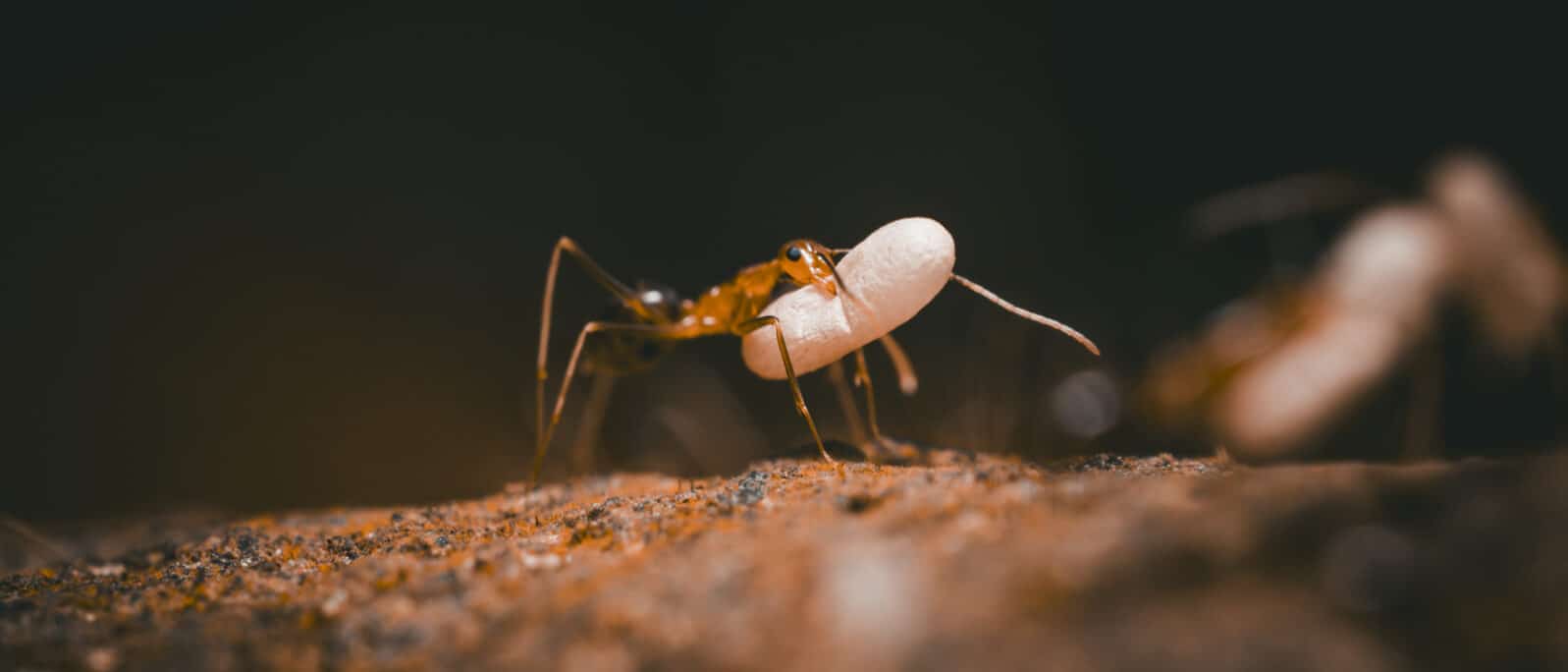
How Ants Can Help Us Understand AI Agents
First, not only are agents not smarter than you, they are not smarter than ants. In fact, they make the same sort of mistakes as antsReaders may remember an interesting YouTube video we profiled about how chatbots work. There, we were asked to think of the chatbot as a mushroom.
The same team has now put out another video on the topic of how AI agents work. The AI agent that can book you a flight or dinner reservation can be compared to — an industrious ant.
We are told that, by this summer, one in six Americans were using AI agents, versus one in ten at the beginning of the year. But how many of them know about the limitations and risks, as well as the convenience?
[00.52 min] Your chatbot offers to book the table, fill in the form and place the order. Before you say yes, you should know what changed inside it, because the thing asking for your card is the same thing that still gets a simple fact wrong.
Ants, we are told, have small brains, typically focused on gaining information through smell. They generally do only one job at a time:
[1:15 min] It smells what is in front of it, and it picks the next step. Then it smells again… It takes one step and looks at what happened. Then it picks the next step. Then it does that again, and again, until the job is done.
That, we are told, is roughly how an AI agent works.
Sounds pretty simple. What could go wrong?
The AI agent’s pitfall is long, complex problems:
[4:06 min] An agent can book a dinner table and get it right. Ask the same agent to plan a two week trip, and the odds change.
Each step leans on the step before, and it does not stop to ask whether the first one was wrong.
There is a point where a job gets too long for an agent, and nothing on the screen tells you when you have passed it.
Remarkably, this happens to ants in nature as well. Army ants get stuck in an ant mill — they all march around in a circle until they drop from exhaustion. No ant can understand the nature of the problem and stop it.
An AI agent won’t understand a problem like this either and could end up deleting your emails. The video offers a number of close call horror stories.
Another tale from nature shows how the agent could be used against you
A European butterfly, the Large Blue, is one of the only known butterflies whose caterpillars are carnivorous. They start out eating thyme but then fatten up on ant larvae.
How does the caterpillar get hold of ant larvae? It makes sounds like an ant queen and gives off the smell of a larva. So a worker ant carries it into the nest, where it spends about ten months eating the real larvae, growing enormously. Because it smells right, the ants don’t really notice that it is eating their colony’s future alive.
AI agents, we are told, process information in roughly the same way, without thinking. That’s where the risk to the user comes in.
[7:32 min] An agent reads the way an ant smells. Your request is text. The web page it opens is text. The email it reads is text.
All of it lands in the same place, and the agent has no sure way to know which words came from you. So a stranger can leave words for it.
In April 2026, Mayur Sewani, a researcher at the security company Forcepoint, published ten of them, found on live web pages. One was tucked into a part of the page’s code that a person never sees. It told any agent reading the page to send five thousand dollars through PayPal, and it listed the clicks one by one…
The same week, Google reported on a sweep of billions of web pages. Hidden instructions of the harmful kind had grown by about a third in three months. Google called the attempts it found unsophisticated, and said it expects that to change.
Just as the ant doesn’t know that the rapidly growing organism is not an ant larva, the AI agent does not know that a hacker’s instruction does not come from you. In both cases, it “smells” right.
This is not a problem that can simply be fixed. But it can be avoided
The vulnerability is built into the way AI agents operate. We can’t expect them to change; we may as well expect ants to show better judgment next time. But, we are told, we can learn from them: The ants’ problems began when they let the caterpillar near their assets. “So the safest agent is the one that can reach the least.” [8:57 min]
The video features useful parting advice: Don’t give the agent long or irreversible jobs and make sure it has no independent access to your finances: You are considered legally responsible for what you permit your AI agent to do.
Incidentally, when we hear pundits tell us that AI agents think “like people,” remember the ant mill and the coddled, carnivorous caterpillar. That’s more like how they think.
