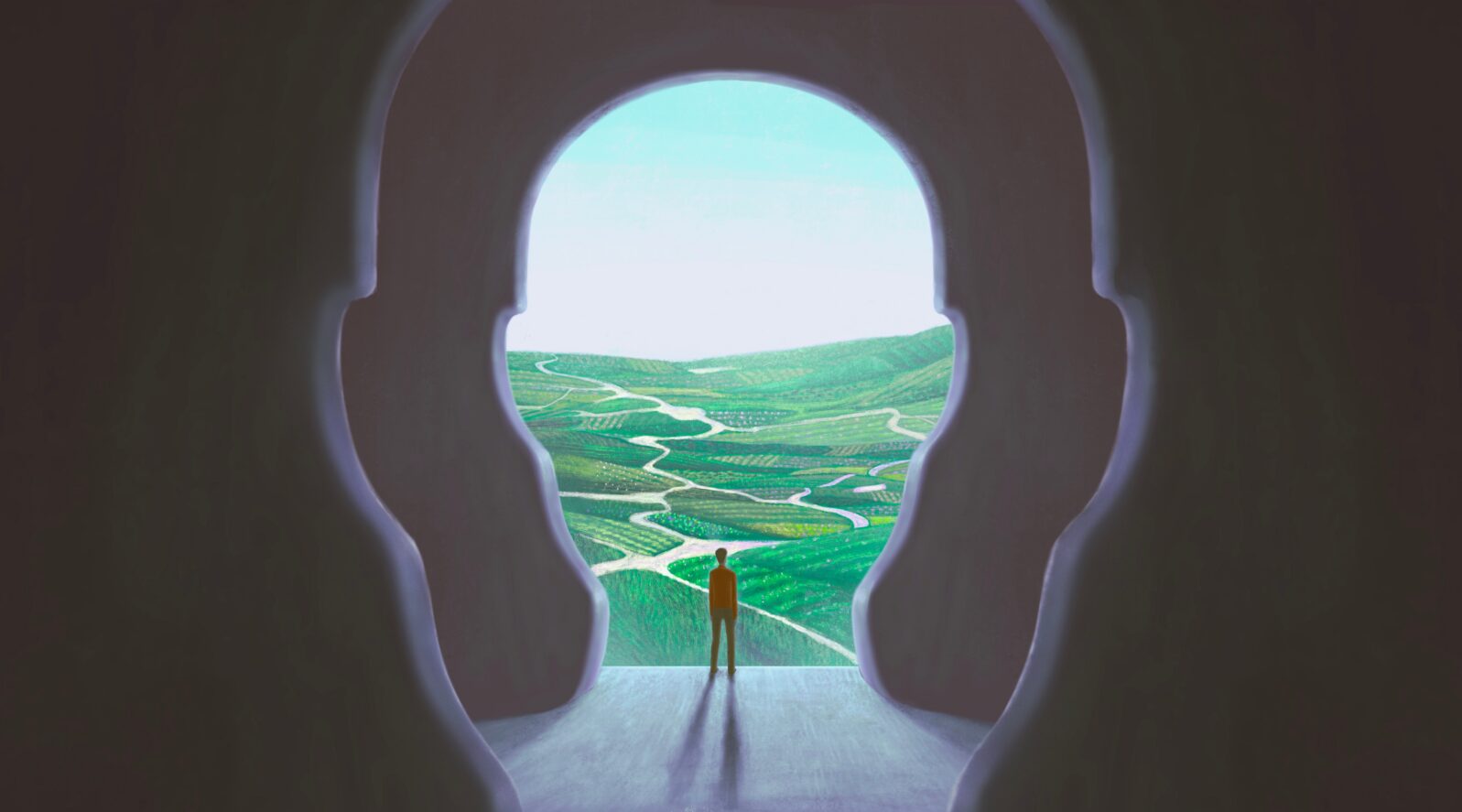
COSM 2026: Why Are There Minds at All?
Neuroscientist Gaurav Suri says that our minds switch on once matter becomes complex enough.Note: Myers will be speaking at COSM 2026: Reality Check, November 18–20, along with many distinguished AI pros, and you can still get a ticket here. This article is the fifth in a series.
Ask where minds come from and you will usually hear one of two answers. One answer is that something beyond the physical world put them here. The other is that physics, chemistry and evolution produced them on their own.
Gaurav Suri, co-author with Jay McClelland of The Emergent Mind (2025), takes the second road, and takes it carefully. But his account leans on a phrase worth slowing down for: “sufficient complexity.”
Where the Mind Switches On
Suri suggests that conscious pleasure and pain may be “only possible in brains of sufficient complexity,” and that simple creatures such as the sea slug manage without them. Artificial networks, he notes, follow a similar pattern: certain abilities stay flat as models grow, then appear abruptly once a model crosses an “emergence threshold.”
He closes off one alternative. Some philosophers, called panpsychists, hold that a faint glimmer of experience runs all the way down into matter itself. Suri’s framework, he writes, “does not posit that simple physical systems have a form of proto-consciousness.” So, on his view, the mind has to switch on somewhere, once matter is arranged the right way.
But Is Complexity Enough?
Complexity comes in degrees. Experience and understanding seem to be different kinds of thing: either something feels like something, or it doesn’t. How does adding more of one kind of thing produce another kind?
Complexity alone can’t be the whole answer. Hurricanes, economies and the internet are staggeringly complex and no one credits them with minds. To his credit, Suri doesn’t stop there. What matters, he argues, is a particular organization: sustained, two-way signaling across networks of neurons. And against those who think the hardware is irrelevant, he insists that “the mechanisms do matter.” That is a sharper claim, and it opens an interesting door.
An Older Answer
If what makes a mind is organization rather than stuff, Suri is close to what Aristotle (384–322 BC) called form. For Aristotle, the soul is not a ghostly second ingredient added to the body. It is the body’s form: the organizing principle that makes a given assortment of matter a living, perceiving thing rather than a heap of chemicals. On that view, asking what a mind is “made of” is already a materialist way of framing the question. The better question is what kind of activity thinking is.
Here the old view and the new one part ways. Aristotle argued that the intellect, unlike sight or hearing, works through no bodily organ. His reason was not theological; it derived from what thinking does. You can grasp the concept of triangle as such, not just this drawn triangle or that one. Every physical pattern is a particular thing. How could a particular thing, however complex, be about triangles in general? Thomas Aquinas later built much of his account of the human person on this argument.
At COSM I will put this question to Jay Richards first, then ask Suri to respond: Is a mind something that matter produces, or the form that makes matter into a living, thinking thing?
Scout’s Rule
Suri explains his method with a story. A teenager named Scout watches ants take the shortest path around a rock. Her friend shrugs that ants are just designed that way, but Scout wants a mechanism she can observe, measure and test. Suri and McClelland count themselves on Scout’s side.
Scout’s rule is a good working rule for science. But it is a rule about how to look, not a finding about what exists. By itself, it can’t rule out that some features of the mind lie beyond what it was built to measure.
There is a further puzzle, which I raised in an earlier post, “An Honest Book Meets the Hard Problem,” by way of the philosopher Alvin Plantinga. If minds switched on at a threshold through processes that reward survival rather than truth, what grounds our confidence that they track the truth, including the truth about themselves?
What to Listen For
- Threshold or kind? Where does the mind switch on, and is “switching on” even the right picture?
- Pattern or form? Is the organization Suri describes just a description of what neurons do, or is it something real that explains them?
- Physical all the way up? Can grasping an idea in general be the work of any particular physical thing?
- Does method settle metaphysics? Does Scout’s rule tell us what is real, or only where science can look?
Join us at COSM 2026: Reality Check for the What Makes a Mind? session in Scottsdale, November 18–20; our panel is now on Friday, November 20, at 10 a.m. Register. Venue. Agenda.Speakers.
Next, and last, in this series: Kindness, free will and the Good Samaritan.