An Honest Book Meets the Hard Problem
The Hard Problem is, of course, the problem of consciousness. Why does anything "feel like" something?Note: Myers will be speaking at COSM 2026: Reality Check, November 18–20, along with many distinguished AI pros, and you can still get a ticket here.
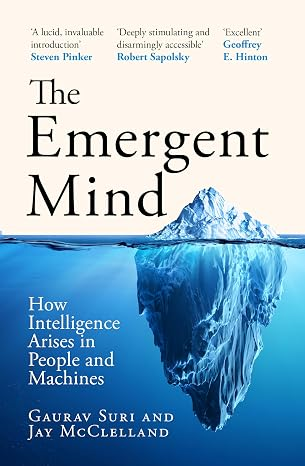
Here’s a preview of the third thread of our COSM 2026 panel on Gaurav Suri‘s recent book, co-authored by James McClelland, The Emergent Mind.
Smell a rose and something happens that no brain scan can show you: it smells like something. Suri and McClelland use that very example in The Emergent Mind. Consciousness, they write, is “the vivid, subjective experience of being aware of ourselves and the world around us (It feels like something to smell a rose).” Explaining that feeling may be the hardest problem in all of science, and it is the third thread of our COSM panel.
The Hard Problem
Philosophers have given this puzzle memorable shapes. Thomas Nagel asked, “What it is like to be a bat?” and argued that a creature is conscious if there is something it is like to be that creature. Frank Jackson imagined Mary, a scientist who knows every physical fact about color but has lived her whole life in a black-and-white room. When she finally sees a red rose, does she learn something new? David Chalmers named the difficulty “the Hard Problem”: we can explain what the brain does, but why is any of it felt at all?
What makes Suri and McClelland’s treatment unusual is its honesty. Many books on the brain promise to explain consciousness and quietly explain something else. These authors say plainly that “understanding how these neural network processes produce the experience of consciousness remains elusive.”
A Striking Admission
Their reason is interesting. Throughout the book, they build neural network models of perception, memory, decision-making, language, reasoning and motivation. “Notably,” they write, “none of these networks required us to assume anything about consciousness.” They go further. Scientists have proposed many jobs for consciousness, such as tagging experiences as pleasant or painful or broadcasting information across the brain. The authors respond, “we, however, do not see why any of these (or related) functions could not occur without being accompanied by consciousness.”
That leaves them, in their words, in “a state of curious uncertainty” about whether consciousness does anything at all. They describe two possibilities they find “equally attractive.” In the first, consciousness “accompanies certain states of brain activity” but adds no causal role of its own. In the second, “consciousness itself might play a causal role in guiding aspects of our neural activity,” a possibility they take seriously because “evolution selects organisms with consciousness.”
This is a candid place for a scientific book to land, and it opens a fascinating set of questions. If our feelings do nothing, why would evolution have produced them? And if they do something, what is the something, over and above the neurons? The question reaches beyond feelings to reasoning itself. The philosopher Alvin Plantinga has argued that unguided evolution rewards behavior that helps us survive, not beliefs that are true. If our minds are products of that process alone, what assures us that our reasoning is reliable, including our reasoning about the brain? Philosophers have argued about this choice for more than a century, and readers of our first article will recognize both options on Paul Churchland’s map of theories of mind. Where the authors stand is a question I look forward to asking on stage.
The Puzzle of Meaning
Consciousness has a quieter partner that is just as puzzling. Philosophers call it intentionality, which has nothing to do with intending. It means ofness or aboutness. I’m thinking about a song. I have a belief about Paris. I have a fear of spiders. Your thoughts point beyond themselves to things in the world.
A simple example shows why this matters. Does a pocket calculator add? In one sense, yes. But it adds only because its designers built it to, and because we read its outputs as numbers. Its meaning is borrowed from us. The philosopher John Searle called this derived intentionality, as opposed to the original intentionality of minds.
Suri and McClelland make a related observation about today’s AI. The goals that organize these systems, they write, “are largely those of their human designers, who curate their training data and design the reward protocols.” When a chatbot answers your question, its answer is about your question because you asked it. That raises a question worth putting to any theory of mind: if a machine’s meaning is borrowed from us, where does ours come from?
What to Listen For
When Gaurav Suri and Jay Richards take the stage, I’ll invite them to take up these threads. Does consciousness do anything, and if so, what? Is there a principled difference between a calculator’s borrowed meaning and our own? And could a being do everything we do without anything being felt at all? Their answers will go to the heart of what we mean by a mind.
Join us at COSM for the What Makes a Mind? session in Scottsdale, November 18–20; our panel is now on Friday, November 20, at 10 a.m.
Next in this series: what today’s AI can, and cannot, tell us about minds.