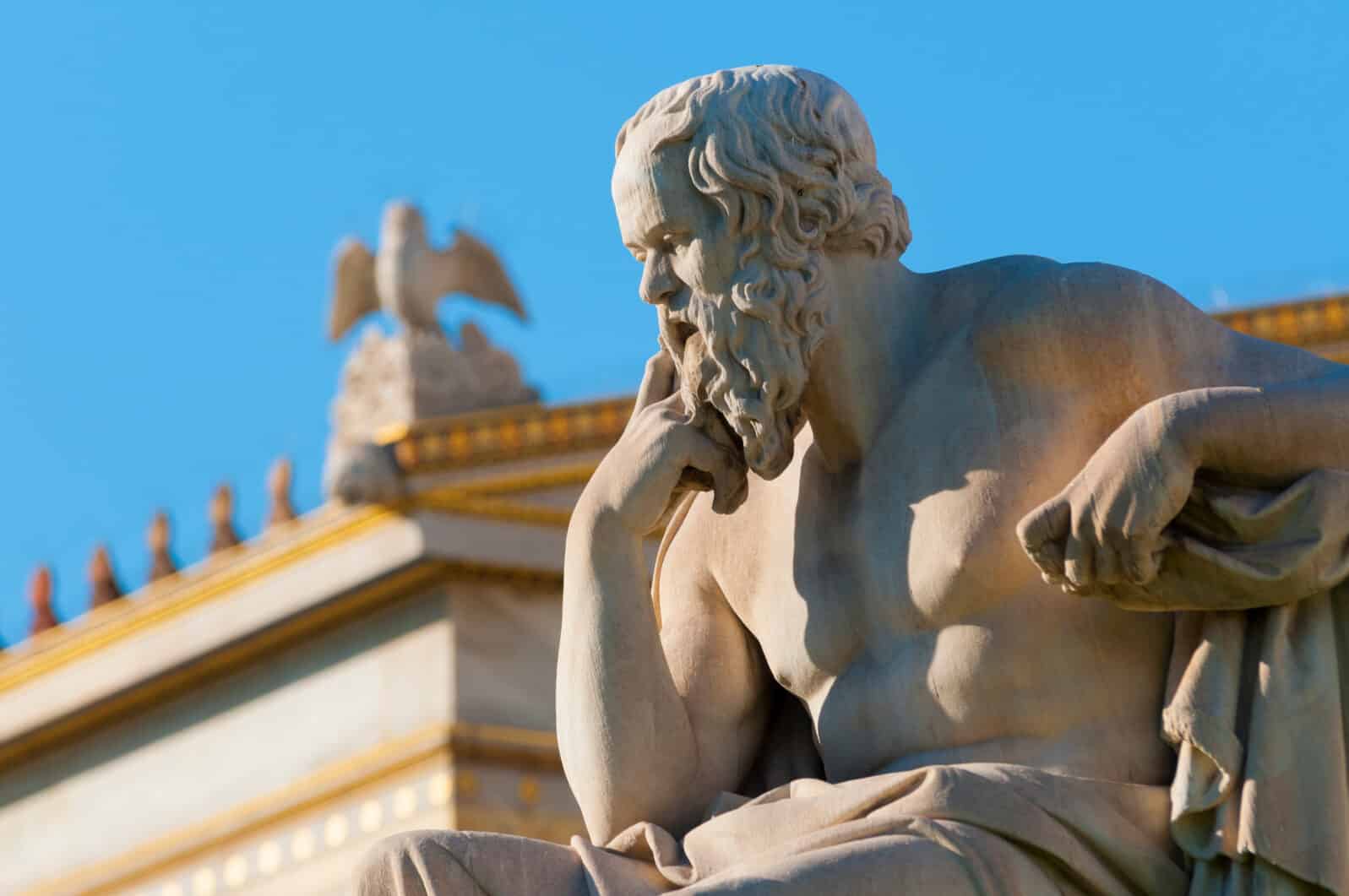
My Brand-New Tech Idea Turned Out To Be … Socrates!
This experience was a useful reminder that sometimes what looks like the frontier of science and technology is just another path into philosophyThere is something exciting about exploring ideas at the boundaries of computers, algorithms, and intelligence. Occasionally, you stumble upon something that feels genuinely new. For a brief moment, you get that wonderful feeling: perhaps you have seen something others have missed.
There is also something deeply humbling about discovering that your brand-new idea is actually 2,400 years old.
Remember the monkey?
A few months ago, I wrote an article about the “monkey with a typewriter” argument that random actions can create meaningful information: give a monkey a typewriter, enough time, and enough random keystrokes, and eventually it will type out the works of Shakespeare.
My problem with this argument was not, as is often assumed, the probability issue. It was the word find. Imagine that the monkey actually types Hamlet. How would the monkey know? To recognize that something has been found, there must be some criterion by which success can be distinguished from failure. If we search randomly through combinations of letters until something from Shakespeare appears, something must recognize Shakespeare’s work when it does. Otherwise, Hamlet is just another sequence among the infinitely many other possible sequences, indistinguishable from each other.
We can, of course, provide that criterion. We can store the complete works of Shakespeare and compare every generated string against them. We can construct a fitness function that rewards strings as they become increasingly similar to Shakespeare. We can build a sophisticated algorithm that guides the search toward English words, sentences, and eventually, whole plays.
But notice what has happened. The information that tells the system what it is searching for has entered the system. The monkey did not find Shakespeare. We did.
That question has occupied me for some time, particularly in thinking about functional information and intelligence. Can a system search for a function that it does not already possess? Can it generate genuinely new functional information, as opposed to merely searching through possibilities according to criteria already given to it?
I thought I was wrestling with a modern problem. Then I met Meno.
Meno’s Paradox
In Meno, the Greek philosopher Plato (c. 427 – 348 BC) offers a dialogue between his teacher Socrates (470–399 BC) and a political figure of the day named Meno.
Meno asks Socrates a deceptively simple question. How can you search for something—a virtue, a mathematical truth, or any unknown object of inquiry—when you do not know what you are looking for?
If you already know what it is, there is no reason to look for it. But suppose you genuinely do not know. How do you search for it? And even more importantly: if you encounter it, how do you know that you have found it?
This became known as Meno’s paradox, or the paradox of inquiry. And, as we can see, it is approximately 2,400 years old.
When I first realized the connection, I was astonished and, I have to admit, humbled. Here I was thinking about algorithms, artificial intelligence, random search, optimization, and functional information—and Socrates had been waiting for me for more than two millennia.
The monkey trying to find Shakespeare is Meno standing before Socrates but now dressed up in computational “clothing.” The language has changed. The machinery has changed. We now have computers capable of searching spaces unimaginably larger than anything Socrates could have conceived.
But beneath all that machinery sits essentially the same question. How can you find something if you do not know what you are looking for? And perhaps more importantly, how can you recognize something as a discovery if you possess no criterion by which to recognize it?
Meno’s Paradox does not show that discovery is impossible. Socrates himself certainly did not stop at the paradox. But it exposes something that I think is easily hidden by the extraordinary scale of modern computation. Generating possibilities is not the same thing as recognizing a new function. Searching is not the same thing as knowing what constitutes success. And producing something new is not necessarily the same thing as generating the information that makes that new thing functional.
We can make the monkey type unimaginably faster, but Meno’s question remains.
Jastrow’s mountain
 Image Credit: Delicious -
 Perhaps I should not have been surprised. After all, astrophysicist Robert Jastrow (1925–2008) had warned us about this before. In his famous reflection on scientists struggling to accept the consequences of an expanding universe—and the implication of a definite beginning in time—Jastrow wrote:
For the scientist who has lived by his faith in the power of reason, the story ends like a bad dream. He has scaled the mountains of ignorance, he is about to conquer the highest peak; as he pulls himself over the final rock, he is greeted by a band of theologians who have been sitting there for centuries.
I would slightly adjust Jastrow’s wonderful image. I would add philosophers sitting alongside the theologians at the top of that mountain waiting for centuries or, in this case, millennia.
Science and engineering help us to climb. We formalize problems. We construct models. We run experiments. We build machines. When something is unclear, we try to make it precise enough to be measured, tested, or computed. And there is something wonderful about that climb.
But occasionally, after struggling upward for long enough, you pull yourself over a rock believing that you have reached some new territory. Then you look up. Someone is already there.
In my case, it was Socrates. He had been there for roughly 2,400 years.
Socrates waiting at the top
I hate to admit (as a Greek myself) that I was not familiar with Plato’s Meno when I was formalizing my objection to randomness as an explanation for the discovery of new functions. I only recently came across Meno’s Paradox and when I first realized the connection, I was astonished and overwhelmed with awe.
That made the experience far more meaningful to me. I am climbing my own mountain of ignorance, using my computers, my questions, my definitions of functional information. I am struggling with search spaces and algorithms, asking whether a system can generate a function without already possessing the information necessary to specify or recognize that function. Eventually, exhausted but rather pleased with myself, I pull myself over the final rock.
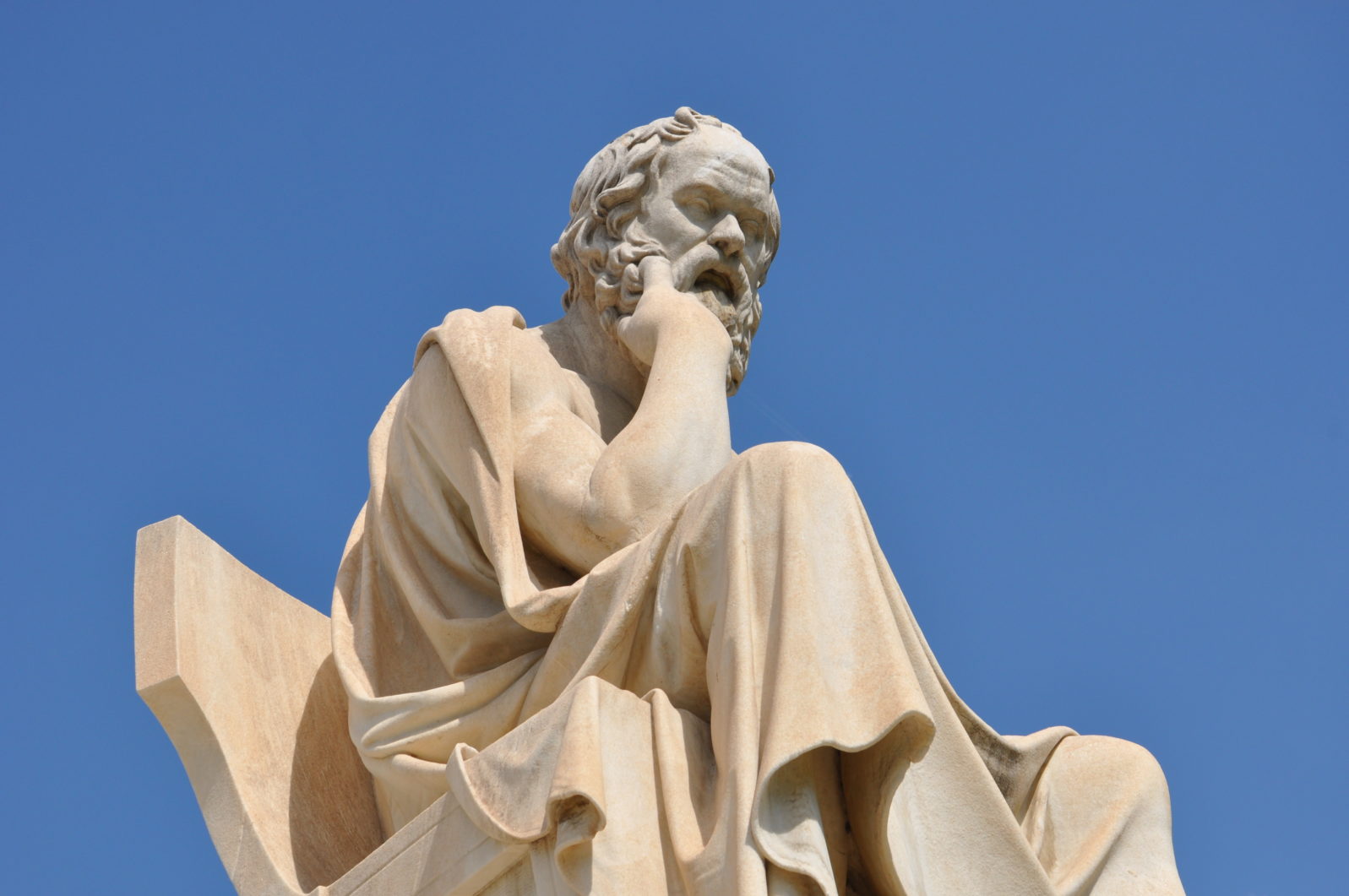 Image via AdobeStock
And there is Socrates looking down from the top. He gives me a slight pat on the back, as if to say: Took you a while, but you made it. A small lesson in humility.
There is nothing wrong, of course, with rediscovering an old question in a new form. Every generation encounters these questions through the intellectual tools available to it. Plato had literary dialogue. We have mathematics, computation, artificial intelligence, and experiments. Perhaps these tools allow us to illuminate aspects of an old problem that could not previously be examined.
This experience was a useful reminder that sometimes what looks like the frontier of science and technology is just another path into philosophy. And sometimes, after climbing for a very long time, you discover that someone has been waiting at the top long before you.
But if randomness alone cannot explain how genuinely new functional concepts are recognized or generated, another question immediately arises: where do such ideas come from? How did Socrates arrive at his? How did I arrive at mine?
Socrates held that learning is, in some sense, recollection: the recovery of truths already known by the soul but forgotten. Others may think of such insights as spiritual gifts. They may even choose to thank Him for all the gifts He has so generously given. Perhaps they may even ask His forgiveness—for eagerly receiving those gifts, only to turn around and present them as their own.
Many modern scientists would, of course, find such claims preposterous. That is—until they reach the top of the mountain.
