UFOs and Crop Circles: Believe It — or Don’t
Alleged evidence of extraterrestrial visits often evolves from local news headlines into a game, an art, and an industryMagical things have been seen in the skies for thousands of years, often interpreted by Earthlings as visitors from other planets. In modern times, unidentified flying object (UFO) sightings have become a popular hobby. Established in 1974, the National UFO Reporting Center has compiled a list of nearly 100,000 UFO sightings, an average of more than five a day.
There have been more UFO sightings in California than in any other state, indeed more than in New York, Texas, and Massachusetts put together. Perhaps aliens prefer California, or maybe California really is la-la land. There have also been more reported UFO sightings in the U.S. on the week of July 4 than during any other week of the year, which shows that aliens like to watch fireworks as much as Americans do (joke).
Australia’s “Tully nests”
On a foggy January morning in 1966, an Australian farmer named George Pedley heard a hissing sound. When he looked for the source, he saw a flying saucer ascend “in a puff of blue vapor” from a nearby swamp known locally as Horseshoe Lagoon. On closer inspection, he found a 30-foot circle of weeds that had been pressed flat in a clockwise direction, as if the weeds had been flattened by spinning air from a flying saucer.
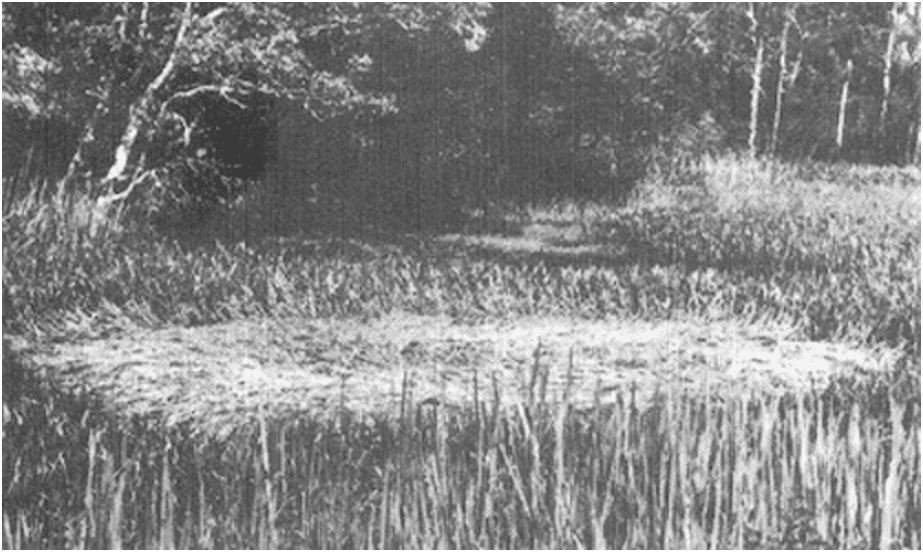 Figure 1: A Tully nest/
The local newspaper ran a story about Pedley’s saucer sighting and soon his neighbors discovered five more “saucer nests.” These were all near the town of Tully in Queensland and they became known as the Tully nests.
Local residents told the Royal Australian Air Force that circular weed patterns were common that time of year. An investigation by a local police officer and professors at the University of Queensland concluded that the circles were most likely caused by short-lived whirlwinds called willy-willies in Australia.
Nonetheless, the idea that extraterrestrials were touring Tully resonated with UFO fans — and locals were happy to offer lodging and stories to tourists who came to see the Horseshoe Lagoon and squint at faded photographs of saucer nests.
Crop circles hit the news in England
A dozen or so years after the Tully nests were reported, designs created by flattened crops of canola, barley, wheat, or other grains began showing up in farmers’ fields in southern England. Some suggested that sexually active hedgehogs may have created these crop circles. (No, this time I am not joking!) Even less plausibly, a molecular biologist named Horace Drew proposed that time travelers from the future were leaving markers to help them navigate our planet (or, at least, England). Never mind that the crop circles disappear when the crops are harvested.
Dust devils and bizarre wind patterns might explain simple circles like the Tully nests, but cannot explain the increasingly precise, complex patterns found in England. Aliens and time travelers were popular explanations. Many of the crop circles were in the county of Wiltshire, the home of the Stonehenge and Avebury prehistoric monuments, and a fertile area for tales of haunted houses, demonic dogs, and sacred geometries. Crop-circle enthusiasts (“croppies”) began compiling detailed records of crop-circle sightings and traveling thousands of miles to absorb spiritual experiences by hugging the canola or lying down inside a crop circle.
Some people, who clearly had too much time on their hands, claimed to have decoded secret messages, such as “believe,” “there is good out there,” and “we oppose deception.” They did not explain why extra-terrestrials would waste their time traveling to earth to create vapid coded messages. Another theory was that the circles were some sort of secret code related to the pre-Columbian Mayan calendar’s Long Count and first Great Cycle, a 5,125-year period that would culminate in the end of the world on December 21, 2012. (Spoiler alert: nothing special happened on that day.)
Questions arose… and so did answers
There were doubters and a few obvious questions. Why are crop circles created at night in remote areas near roads? Why are aliens so fond of farms in southern England? Why would extraterrestrials use secret codes if they had something to tell us?
In 1991, two Brits, Doug Bower and Dave Chorley, confessed that they had made hundreds of crop circles using boards with rope handles to smoosh the crops.
One night in 1978, they had been sitting in a pub, drinking warm English beer and talking about the Tully nests. They decided it would be a hoot to create flattened crop circles to make it seem that flying saucers had landed in English fields. The croppies bought their decades-long prank hook, line, and sinker.
A game, an art form, and an industry
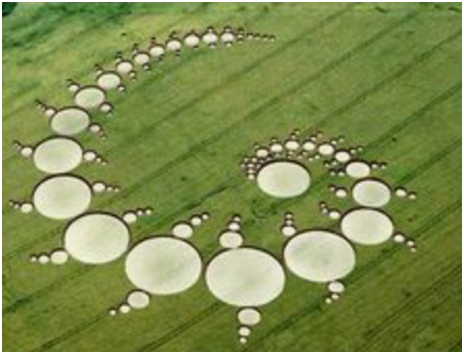 Figure 2: The Julia Set Crop Circle/
Crop circles have evolved into an elaborate game. Pranksters and locals both appear eager to keep the story going. Pranksters like messing with the croppies and enjoy creating competitive crop-circle art, enhanced by the thrill of avoiding being caught. There are implicit rules: the circles should be created at night, anonymously, with no incriminating evidence of human involvement. Crop-circle creators now think of themselves as artists and often use sophisticated tools to aid their increasingly complicated designs. Photos of the best designs are published in books, catalogues, and calendars.
Local farmers are annoyed that parts of their crops are damaged, first by the pranksters and then by trespassing tourists. But many locals are more than happy to sell lodging, tours, and souvenirs to the thousands of New Age visitors who arrive during each crop circle season. Some towns have pilots flying over their fields daily in order to take pictures of fresh designs that can be downloaded to the internet and lure more tourists.
Many croppies acknowledge the pranksters but insist that some patterns are too complex to be made by humans working for a few hours in the dark. One croppie insisted that,
I can tell a real one, by the energy I feel once inside it. Different crop circles seem to resonate different energies, which I usually feel within my chakras . . . . Each one is different, some seem to energize me, giving me a real buzz, others make me want to lay down in them, and be very still.
The spectacular crop circle shown in Figure 2 above appeared in July 1996 near Stonehenge. The design is a fractal pattern called the Julia Set and was said to have appeared in less than an hour during the daytime — seemingly ruling out human pranksters. The owner of the field that provided the canvas for this pattern reportedly made about £30,000 charging admission to his field.
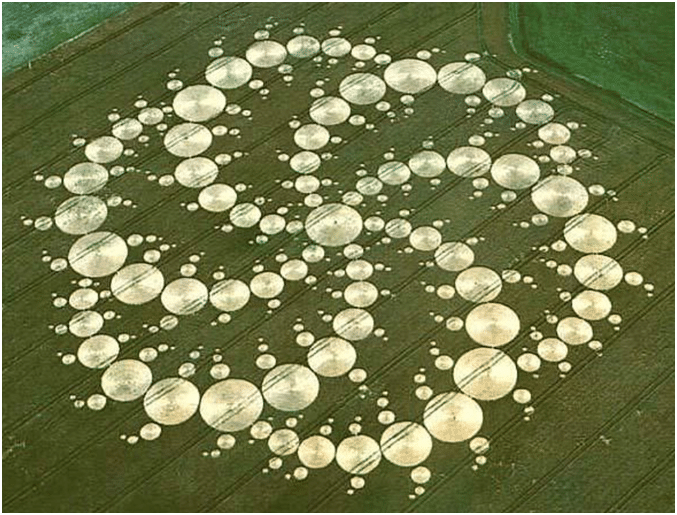 Figure 3 A 2001 Crop Circle in Wiltshire, England Containing 409<br>Circles/
Three pranksters later confessed that they had created the pattern in about three hours in the early morning the day before and they were noticed by an airplane. An even more elaborate double-triple Julia Set pattern is shown in Figure 3 (pranksters unknown).
In a bizarre full-circle take on the crop-circle saga, a 2009 BBC article titled “Stoned wallabies make crop circles” stated that a government official in the Australian island state of Tasmania had reported that “we have a problem with wallabies entering poppy fields, getting as high as a kite and going around in circles.” (available at Reuters)
(This article is excerpted from Smith, Gary (2023), Distrust: Big Data, Data-Torturing, and the Assault on Science, Oxford University Press. Links and headings have been added.)
