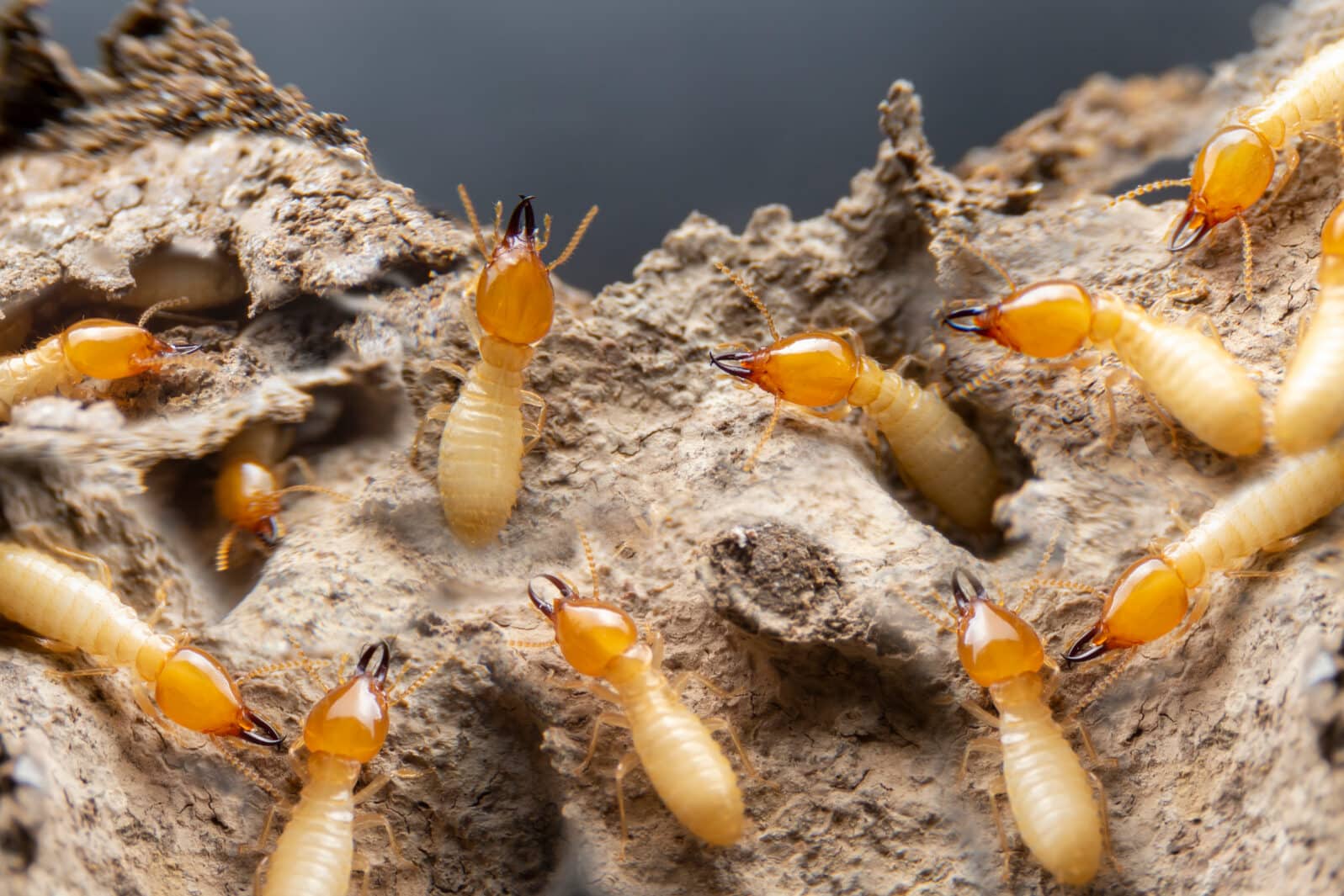
Monday Micro Softy 81: Termites Are Surprisingly Smart
Provided we agree to count swarm intelligence, which we also use in computer scienceArtificial intelligence isn’t just large language models or image-generating transformers. Another rich vein of AI is swarm intelligence — lessons from nature on how dumb bugs do smart things collectively. Dumb bugs, each doing a simple task, work together to build bee hives, hornet nests and termite villages. Their collective effort is called the emergent behavior of simple actions.
Ants, for example, use chemical communication to find the shortest path between food and their nest. When a scout ant discovers something desirable — say, a Snickers bar — it heads back home, all the while laying down a trail of pheromones, chemicals that trigger behavior in other ants. The other ants pick up this scent and follow it. They reinforce the trail with their own pheromones if they reach the food successfully.
At first, ants may explore multiple routes, but shorter paths allow them to make more trips in less time, which means those trails receive pheromone reinforcement more frequently. Over time, the shorter route becomes much stronger in scent and more heavily trafficked, while longer routes fade away because they’re reinforced less often. This collective feedback loop, powered by simple pheromone signals, enables the colony to converge on the shortest and most efficient path to and from the Snickers bar. (Fun fact: Most of the Snickers bars in the US are made where I live and work: Waco, Texas.)
If you spot a line of ants traveling back and forth in your kitchen, before you get the bug spray, try this experiment: moisten your finger with your tongue and swipe it across their path. Doing so wipes out the pheromone trail they rely on for navigation. When the ants reach the moistened section, they pause in confusion, unsure of how to proceed at first. (Suggestion: Don’t moisten your tongue a second time.)
This week’s Micro Softy tests your ability to predict emergent behavior when each bug in a swarm follows the same simple rules, given below:
Imagine a group of termites surrounded by scattered pieces of wood.
Case 1: Each termite wanders randomly. When a termite bumps into a piece of wood while not carrying anything, it picks it up. If it is already carrying a piece of wood and then bumps into another piece, it puts the one it’s carrying down. All the termites follow this same simple rule:
- Empty-handed + wood → pick it up.
- Carrying wood + bump into wood → put the one being carried down.
Now ask: what happens when many termites follow these rules at once? What is the emergent behavior?
Case 2: This is the same as Case 1 except that the termite takes a tiny step in the northeast direction and then does a random move. What’s the emergent behavior in this case?
We’ll give the answer next Monday.
Solution to Micro Softy 80: The Digit of Least Significance
We saw last week that any list of numbers that all end in 0, when multiplied, produces a result that also ends in 0. The same holds for numbers ending in 5 or 1.
Last week’s puzzle was about the remaining numbers: 2, 3, 4, 6, 7, 8, and 9. Not all of these numbers preserve their final digit under repeated multiplication, but they show other interesting patterns. For example, what can you conclude when you multiply a long list of numbers that all end in 7? The Micro Softy assignment was to explore each remaining last digit and identify patterns.
 Image Credit: kinara art design -
 We’ll go through the numbers one by one.
- 2: Multiplying two numbers ending in 2 results in a number ending 4. Multiplying that number by another number ending in 2 ends in a number ending in 8. If the list has four numbers ending in 2, their product will end in a 6. Multiplying by one more number gives a total product ending in a 2 and we start over. So the least significant digit pattern repeats: 2‒4‒8‒6‒2‒4‒8‒6‒2‒4‒… and on and on.
- 3: Multiplying two numbers ending in 3 gives a number ending in 9. One more multiplication gives a number ending in 7. The next multiplication by a number ending in 3 results in a number ending in 1. Next is 3 and then we start the pattern again. So we get the repeated pattern of 3‒9‒7‒1‒3‒9‒7‒1‒3… and so on.
- 4: The product of two numbers ending in 4 results in a number ending in 6. The product of three such numbers ends in a 4 and the pattern repeats. The repeated pattern is 4‒6‒4‒6‒4‒6‒… and so on.
- 6: The number 6 also has the interesting property that a list of numbers ending in 6, when multiplied, results in a number also ending in a 6. This is the same property we saw for 0, 1 and 5.
- 7: Hopefully we now have a firm grasp of the analysis that must be applied. For 7, the patterns is 7‒9‒3‒1‒7‒9‒3‒1…
- 8: Here the pattern is 8‒4‒2‒6‒8‒4‒2‒6…
- 9: For 9, we get 9‒1‒9‒1‒9‒1…
Here’s a summary. For each number from 0 to 9, here are the patterns that repeat themselves.
- 0
- 1
- 2‒4‒8‒6
- 3‒9‒7‒1
- 4‒6
- 5
- 6
- 7‒9‒3‒1
- 8‒4‒2‒6
- 9‒1
So if you multiply 1000 numbers together that all end in 9, and the product is 8,254,815,123,148,325,123,583,678,071,233,637,213 you’ve made a mistake. This number ends in a 3 and, according to the table, the answer must end in either a 9 or a 1.
If you find this fun and want more to think about, consider, what happens when we use a different basis? The answer is simple for binary numbers, i.e. base 2.
The Monday Micro Softy is a weekly feature of Mind Matters News. Here are the links to all the puzzles and answers to date:
Monday Micro Softy 80: The Digits of Least Significance. The patterns found in numbers can be useful as well as fascinating. Last week’s puzzle is also easier to solve if we observe some of the patterns that number theory reveals.
 Image generated with ChatGPT
Monday Micro Softy 79: The Last Digits in Fermat’s Last Theorem. Did Andrew Wiles really prove Fermat’s Last Theorem? Today we offer you a chance to decide. About last week’s MicroSofty: Think of the probability issue as just a distraction…
Monday Micro Softy 78: Card Sharks That Bite Harder. You can beat the odds in some card games if you understand probability theory. Try your chances! Last week’s puzzle, like several others, is easy to solve if we use inclusive thinking about relationships.
Monday Micro Softy 77: Two Proud Texans I’m aware of no other state where businesses and citizens proudly fly their state flag. I live in McGregor, Texas, where Elon Musk’s Space X has a testing center, and occasionally, the testing of their rocket engines gently rattles the dishes on the shelves in my home.
Monday Micro Softy 76: The Smoking Gun explains a computer scientist or engineer, a law enforcement officer often relies on abductive reasoning to crack a case, so with this in mind, you will have to crack last week’s puzzle. You can find puzzles 55 through 75 here as well.
Monday Micro Softy 55: “It happens every spring.” Baseball, that is. Here’s a puzzle that takes in baseball’s summer. To solve last week’s puzzle, you don’t need to know the distance. Check the problem again for the number you do need to know. You can find puzzles 51 through 54 here as well.
