
Are We Really “Unconscious” While Under Anesthesia?
Modern medics rely very much on anesthesia but how it works is not quite clearYesterday, we looked at an article on covert consciousness by associate editor Molly McDonough in the Spring/Summer edition of Harvard Medicine. It’s the consciousness that people in a coma, who appear unresponsive, often show if researchers can communicate with them through brain imaging techniques such as fMRI and EEG.
Engineering & Science, MIT
Another form of consciousness that is poorly understood is what happens when we are under anesthesia. That’s the subject of another of her articles in the same edition. She profiles the work of Emery Brown, a neurologist and professor of anesthesiology at Massachusetts General, the same hospital where the first demonstration was conducted of general anesthesia in surgery.
In the late Eighties, early in his career, Brown faced a conundrum: Modern medicine relies on anesthesia but no one knows just how it works. He wasn’t satisfied with the “If it works, just use it” approach so he started using EEG, recording and analyzing the patterns of brain waves in patients who were under general anesthesia:
Brown went on to demonstrate that anesthesia is nothing like natural sleep; instead, it’s more like a coma, with large, slow oscillations in neural activity that prevent different parts of the brain from communicating. He has shown that different classes of anesthetic drugs create unique EEG patterns and that those patterns differ depending on dosage and a patient’s age and health status. His research has moved the field toward a more rigorous, brain-centered understanding of anesthesia and of unconsciousness itself.
“What Happens to the Brain Under Anesthesia,”
But what if…?
In the interview part of the story, McDonough asked him the question that haunts many of us, What if I am really awake during the procedure? He replied,
Actually, the more common scenario is that if you’re anesthetizing someone and you’re worried about them being awake, your natural action is to give them more anesthesia. So you tend to overdose patients because you do not completely trust the index. People being awake under anesthesia is a horrible occurrence. However, it is very uncommon. What’s more common is that patients wake up with delirium or brain dysfunction because they had too much anesthesia. “Under Anesthesia,”
Part of the problem is lack of reliable monitoring to be sure of exactly what is happening in the brain at the time. That is where Brown’s research comes in. He also tells us something that most of us might just as soon not know (but maybe should):
Before the use of ether for anesthesia was discovered, do you know what the primary area of research was in surgery? It was coming up with better ways to strap patients down. The discovery of ether changed surgery overnight: from butchery and intolerable pain to more humane therapeutic procedures. It has to be acknowledged as one of medicine’s greatest innovations. “Under Anesthesia,”
Consciousness (and unconsciousness) as private worlds
Part of the reason we don’t know exactly how anesthesia works is surely that we do not know what consciousness is (there are at least 325 theories out there) and thus how it works. That handicaps us for understanding unconsciousness.
 Image Credit: Yakobchuk Olena -
 Neurosurgeon Michael Egnor recalls discovering that as a medical student:
When I asked one of my professors, he gave me an answer that gave me the chills.
He said, “Well, the purpose of anesthesia is to make you amnestic [having no memory] and to make you unresponsive.”
And I asked, “But how about unconscious?”
He replied, “It’s not really part of it.”
So Egnor found himself asking,
How do we know that everybody who has surgery isn’t completely conscious during the whole thing and can’t do anything about it at all? And then the memory gets wiped. How would one empirically distinguish that from somebody who was actually unconscious?
I don’t know. And neither do the anesthesiologists.
All we know is that people almost never remember anything after anesthesia. There are patients who have intraoperative memories but I’ve never heard of one, that has been unpleasant.
As he discusses in our forthcoming book on near-death experiences, memories of what happens during the operation — intraoperative memories — are not likely in surgery on the brain because very high doses of anesthetics are used, to avoid sudden movements. Of course, we don’t know if the patient is conscious, only that no one remembers anything (unless, of course, they have a Pam Reynolds-type near-death experience. But then all bets are off.)
Waking the patient up during spinal surgery?
At one time, neurosurgeons used to do that, Egnor says:
We used to do a technique for decades routinely in scoliosis surgery, a wake-up test. You’d have the patient — commonly, an adolescent or a child — on the operating table, under general anesthesia, You’d have their back filleted open. So their whole spine was exposed. You put rods and screws in to straighten the spine.
And the problem is, as you straighten the spine, you can’t see the spinal cord. The spinal cord is inside channels in the bone. And there’s a possibility, when you’re straightening the spine, of inadvertently putting pressure on the spinal cord, or traction on the spinal cord. That could cause paralysis. So, you want to know if you’re hurting the spinal cord as you straighten the spine.
So what would be done is, you would wake the patient up on the operating table and ask them to move their feet while you straighten the spine, to make sure that their spinal cord still works. If they stop moving their feet, you would then take the tension off the spot. And, that was routine. I did it many times, as other spinal surgeons have done.
He adds,
And patients, number one, virtually never have any memory of that whatsoever. And the times that they have, it hasn’t been unpleasant. They don’t have memories of pain. So, anesthesia is a very strange thing.
But then, consciousness is a very strange thing too.
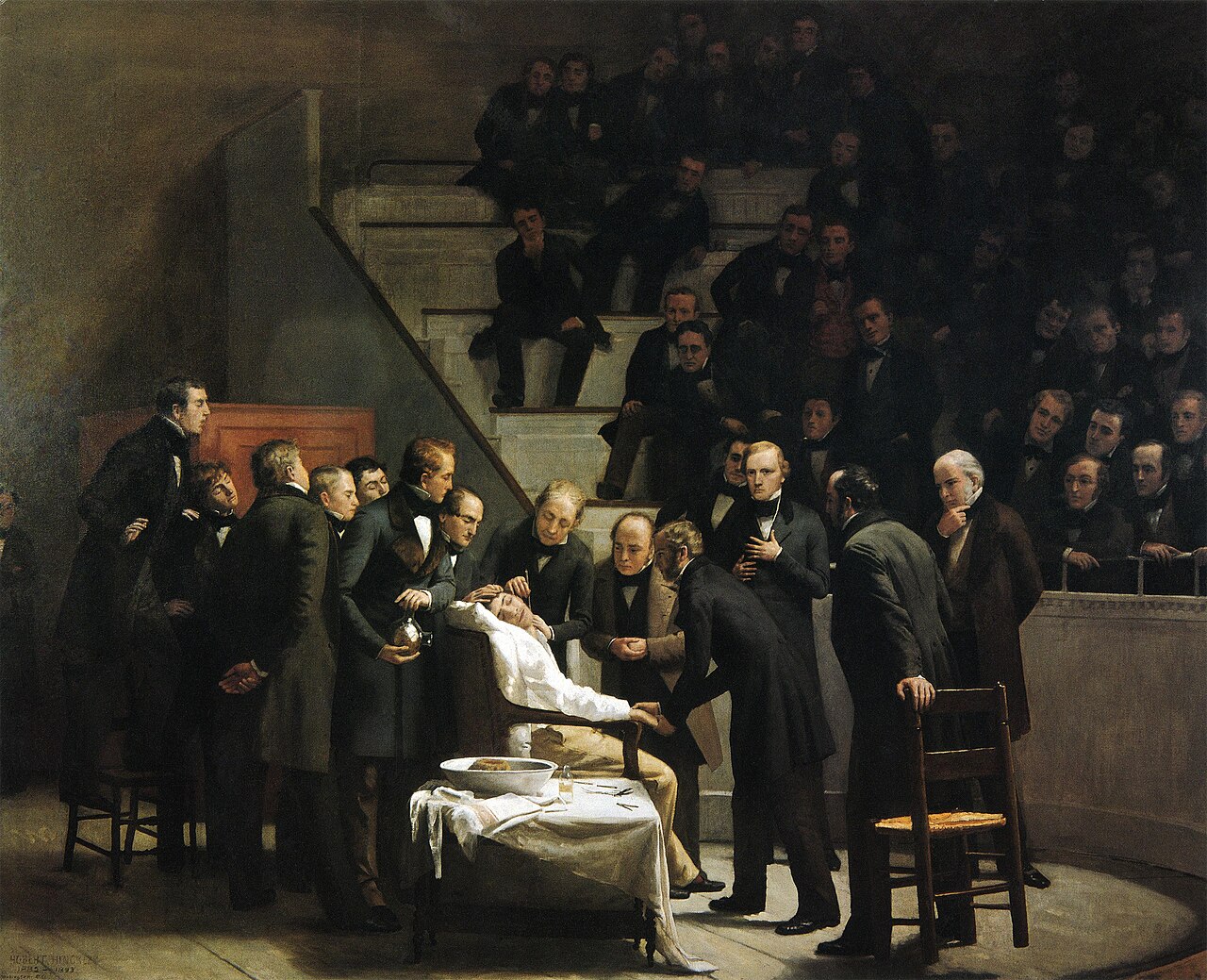 By Robert Cutler Hinckley - “The First Operation Under Ether,” OnView, accessed June 17, 2024, https://collections.countway.harvard.edu/onview/items/show/26609., Public Domain, https://commons.wikimedia.org/w/index.php?curid=149479608