A Long Night’s Journey into the Dark Side of AI
Like AI, the subconscious mind can process a vast amount of information.The core of this essay will focus the ramifications of AI, as well as subliminal messaging and how it affects the human mind and brain which are currently under threat as we enter more deeply into this ‘Brave New World’ of AI/High-Technology.
It seems to me and many other academics, regarding trade-offs, the downsides of AI outweigh the upsides of this potentially menacing phenomenon. The problem is, we don’t fully understand AI’s behavior or what conclusions it will come to, as we can only speculate on such results, many (not all) of which are to our satisfaction.
But don’t take my word for it: Science Fiction writers have over the past 100-plus years been warning us about the horrors of a dystopian future. We are reaching the point where such science fiction stories are now becoming ‘Science Faction’.
Fortunately, many intelligent people are beginning to wake up regarding the potential dark side of AI/High-Technology. They are asking relevant questions: Will robots soon replace human workers and put an end to traditional manufacturing and agricultural farming? Will mass surveillance intrude into our everyday lives, monitoring us as we enter our bathrooms and other such intimate ‘bedroom’ moments and what goes on behind closed doors?
More: Will digital ID control our spending rights? Will the mushrooming of (circa) 5,427-plus (some sources estimate the figure could be 11,000) data centers (‘data’ is a euphemism for surveillance), throughout the USA, extremely restrict American households and hospitals of electricity and household water supply by devouring your energy? Will the dumbing down of society enter a turbo-charged ‘Brave New World’ on AI-soma steroids?
Will High Art die if such advanced mechanical machines replace artists, particularly film-makers, novelists and poets? And what will happen if the AI mega-engines break down, kind of like the plot in E.M. Forester’s Sci-Fi novel? (The Machine Stops – Wikipedia). Regarding AI and religion: Many Christians are already being subjected to this: Discover 11 ways pastors can use ChatGPT to plan sermons, plus a bonus tip. Get practical prompts and step-by-step guidance for ministry content creation. | ChurchTrac Blog
But it gets worse: Text With Jesus is an app that lets users have real-time conversations with “AI versions of Jesus, the Apostles, and other biblical figures.” It’s been covered by CNN, the Washington Post, and the New York Times.
Can AI bots be trusted to solve a problem in a company’s system? Not so, it seems: Rogue AI ‘helper’ deletes company’s database after deciding to think for itself – sparking Terminator-style warning for businesses | Daily Mail Online
There are many more questions, but the above are the core issues into this unknown race for ‘efficiency’ and ‘convenience’. But to what end? For even more ‘efficiency’ and ‘conveniency’ ad infinitum? Think about this the next time you’re on your way to work and you grab a polystyrene cup of coffee ‘to go’, which is so ‘efficient’ and ‘convenient’.
It’s true that the cup is more efficient and convenient than a China cup because it keeps hot water hot and cold water cold, and it is convenient when one is ‘on the move’. However, unlike the old-fashioned China cup, it is contaminated with a boiling swamp of micro-plastics/chemicals that enters your body. So much for ‘efficiency’ and ‘convenience’.
Then there are the propaganda and psy-ops used in semiotics to be considered. For readers unfamiliar with semiotics, it is defined as: The study of signs and symbols, focusing on how they create meaning. It explores how individuals interpret and use signs in various forms of communication, including language, images, and gestures.
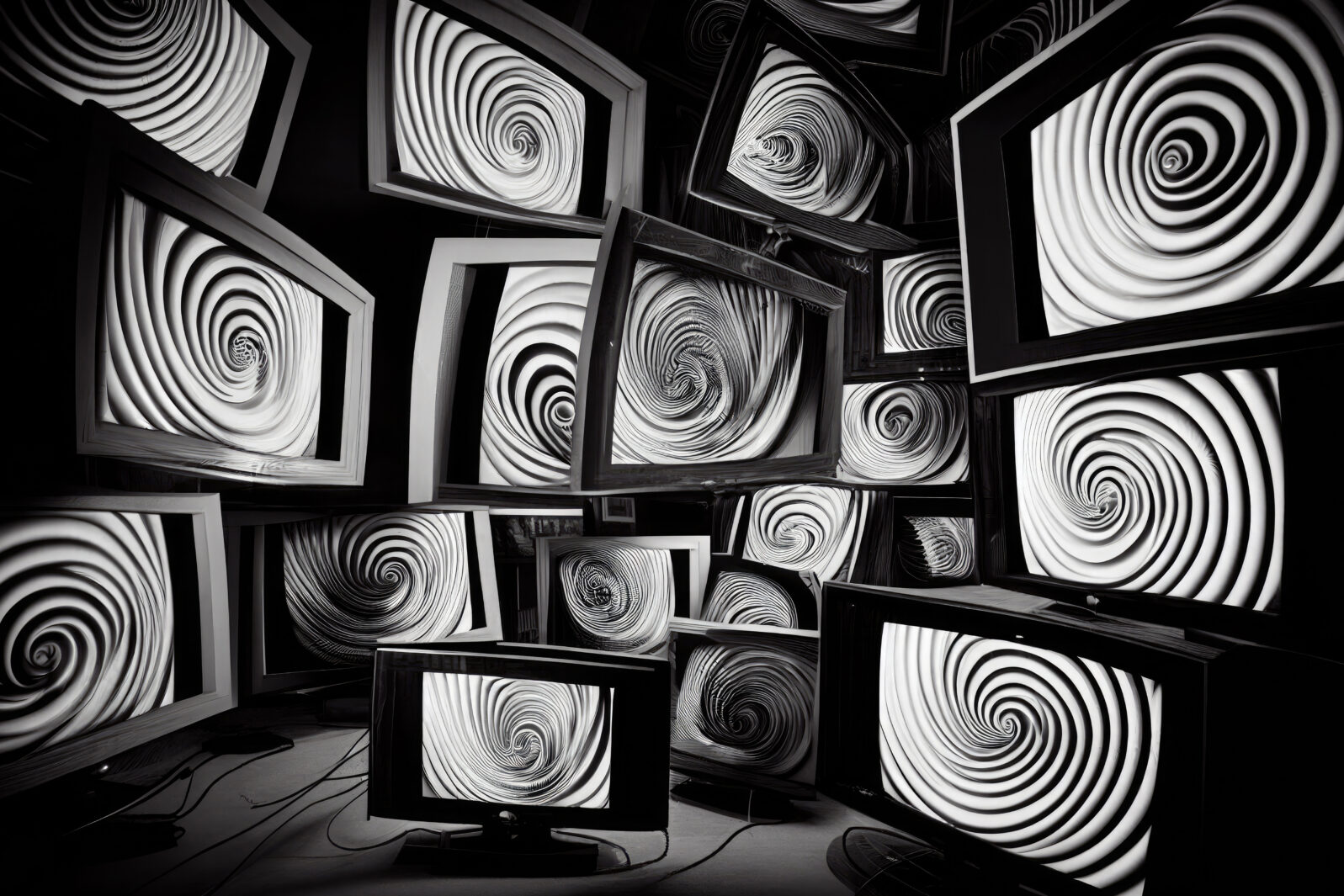
This neuromarketing is when your brain receives signals “below the absolute threshold level” of your conscious awareness. The goal here is to target a certain demographic and influence it in a covert, hidden-grammatical way. The unconscious mind is quite susceptible to this form of ‘hypnosis’, especially on TV or iPhone screens. With the advancement of AI, now, the sky is the limit for what subliminal propaganda psy-ops can do.
Subliminal messages, especially sexual ones, in advertising targets auditory and/or visual signals, tapping into your emotions, and picked up by your semantic subconscious brain without you being aware of them, even when they are not used in a commercial way, according to many studies over the years post-1950s.
For younger American readers of Mind Matters who are unfamiliar with 1970/’80s’ British TV adverts, the term “Cadbury Flake girl” harks back to a series of TV adverts by British confectionery company Cadbury, promoting their Flake chocolate bar.
These highly popular adverts occurred during the 1970s/’80s, and early 1990s. They depicted beautiful women with bee-stung lips luxuriating in the pleasure of eating the chocolate known as the Flake Bar.
The tranquil backdrops for these advert scenes included bubble baths, a rowing boat on a calm river, and flower-filled meadows, all shot in dreamy soft-focus cinematography, with soothing melodies and hints of decadence. The slogan that was used in the commercials was, “Only the crumbliest, flakiest chocolate, tastes like chocolate never tasted before”.
The women in these adverts were depicted holding a phallic-shaped chocolate bar, while peeling back the wrapper, and, targeting the subliminal mind by inadvertently simulating fellatio on the chocolate flake. Some of the women were probably not aware of this decadent symbolism/messaging, but the psychologist scriptwriters were no doubt fully aware of the effect it would have on normie TV viewers. See what you think after clicking on the following link: https://youtu.be/3FcjxpnbHhA
And it was obvious to any discerning person familiar with semiotics on the power of ‘sex sells’ that sometimes a ‘chocolate flake is not always a chocolate flake’. That was over 40 years ago. Think what the power an advanced AI can do today to subliminally sexualize TV or radio adverts. In the blog rareconnections, AI Subliminal Messages: What Are They and How-to Make Them, it claims:
AI subliminal messaging utilize new techniques in generative AI to subtly implant hidden words, logos, or imagery within a larger image. Whether or not the technique is actually subliminal messaging or not is up for debate, but the name has stuck. These images are created with generative AI tools like Stable Diffusion and Midjourney with specific settings and additional inputs to control the final composite image. A user provides the AI with a text prompt and a black-and-white mask image containing their target text or logo. The model will then embed the mask image within the outlines of the generated image which was described by text prompt. While the results may resemble subliminal messaging, the AI is simply following instructions to combine inputs as requested by the user.
Like AI, the subconscious mind can process a vast amount of information, a lot more than the conscious mind. Its incredible power results in subliminal messages influencing our behaviour, thoughts, habits, attitudes, desires, beliefs without the individual being aware of it.
The power of symbolism and metaphors can also be interpreted in poetry. If we take the example in recent times when dilettantes in the media and chattering classes perpetually mined metaphors in a famous poem called The Second Coming by Irish poet William Butler Yeats (1856-1939), written in 1919. (Yeats was not a Christian, he was probably a Theosophist, but I believe he intuitively believed in God, thus his semi-stream of consciousness work manifested in his writings.) The deeply profound opening lines to the above poem are as follows:
Turning and turning in the widening gyre
The falcon cannot hear the falconer;
Things fall apart; the centre cannot hold;
Mere anarchy is loosed upon the world,
The blood-dimmed tide is loosed, and everywhere
The ceremony of innocence is drowned . . .
Could a modern-day interpretation of this poem see the falcon as AI and the falconer as Mankind? This poem was written a couple of decades after the philosopher Fredrich Nietzsche declared ‘God is Dead’ (we know he didn’t mean God is literally dead, as he didn’t believe in such an entity).
In light of that bird of prey in Yeats’s poem, the ‘falcon’ can also be interpreted as people metaphorically turning their backs on their master ‘falconer’, God, and replacing Him with Man being God, or, AI being the New Religion when ‘things fall apart as the center cannot hold and mere anarchy is loosed upon the world’.
We live in an age where things are falling apart. I recently saw a very clever meme procured by the Christian writer and podcaster, Ann Barnhardt, on the internet which said: “If you look carefully at the 1968 movie 2001: A Space Odyssey, it envisions a future in which people eat [over-processed pasty] meals while staring at images on flat, portable rectangular screens. Nice bit of prediction. In the next bit of the movie, AI takes over and kills [almost?] everyone.” (Included are my square brackets.)
Like the TV, these flat portable screens are hypnotic. My worry is that those negative messages emanating from them will take us down a long night’s journey into the dark side of AI.
