
Will Reliance on AI Mean a Vast Drop in New Knowledge Production?
Dependence on AI assistants, for example, was found to greatly reduce discussion among peers, where new ideas are offered and evaluatedMost of the people we hear from on the topic of AI assure us that we are on the verge of great advances of knowledge. But there are at least some reasons for concern about losses in knowledge as well. Here are three areas to think about:
Reliance on search assistants and gen AI (chatbots) may reduce involvement in the processes that generate new knowledge.
 Image Credit: jakapong -
 At the Wall Street Journal, economics commentator Greg Ip began to wonder about that, after seeing demos of ChatGPT at work :
How much knowledge will be lost to AI? Large language models (LLMs) such as ChatGPT, Google Gemini and Anthropic’s Claude excel at locating, synthesizing and connecting knowledge. They don’t add to the stock of knowledge.
When humans answer questions … they often pursue novel avenues of inquiry, creating new knowledge and in–sight as they go. They do this for a variety of reasons: salary, wealth, fame, tenure, “likes,” clicks, curiosity.
If LLMs come to dominate the business of answering questions, those incentives shrivel. There is little reward to creating knowledge that then gets puréed in a large language blender.
“AI Risks Choking Off New Knowledge,” September 7, 2025
He cites the case of Stack Overflow, a software developers’ discussion site where traffic is down 90%, as developers turned to chatbots instead of peers for answers: “The drop was the same regardless of quality, based on peer feedback, refuting predictions that AI would displace only low-value research.” The problem here is that new ideas emerge in the flow of discussion between peers, not from the blended existing information proffered by chatbots.
Knowledge that is excluded from datasets by language barriers may be lost.
At Aeon, Deepak Varuvel Dennison raises another important question: What about all the knowledge that doesn’t get into the gen AI?
For example, data from Common Crawl, one of the largest public sources of training data, reveals stark inequalities. It contains more than 300 billion web pages spanning 18 years, but English dominates with 44 per cent of the content. What’s even more concerning is the imbalance between how many people speak a language in the physical world and how much that language is represented in online data. Take Hindi, for example, the third most spoken language globally, spoken by around 7.5 per cent of the world’s population. It accounts for only 0.2 per cent of Common Crawl’s data. The situation is even more dire for Tamil, my own mother tongue. Despite being spoken by more than 86 million people worldwide, it represents just 0.04 per cent of the data. In contrast, English is spoken by approximately 20 per cent of the global population (including both native and non-native speakers), but it dominates the digital space by an exponentially larger margin. Similarly, other colonial languages such as French, Italian and Portuguese, with far fewer speakers than Hindi, are also better represented online.
The underrepresentation of Hindi and Tamil, troubling as it is, represents just the tip of the iceberg. In the computing world, approximately 97 per cent of the world’s languages are classified as ‘low-resource’. This designation is misleading when applied beyond computing contexts: many of these languages boast millions of speakers and carry centuries-old traditions of rich linguistic heritage. They are simply underrepresented online or in accessible datasets.
“Holes in the web,” October 13, 2025
The risk we run if everyone relies on these online resources is that “everything that is known” on a topic becomes simply “everything that is known in English” or another easily available language. One technical solution might be more use of auto translation systems. But before that happens, the problem must be recognized.
And thirdly…
Irresponsible hype continues to dog efforts to incorporate new AI into knowledge systems.
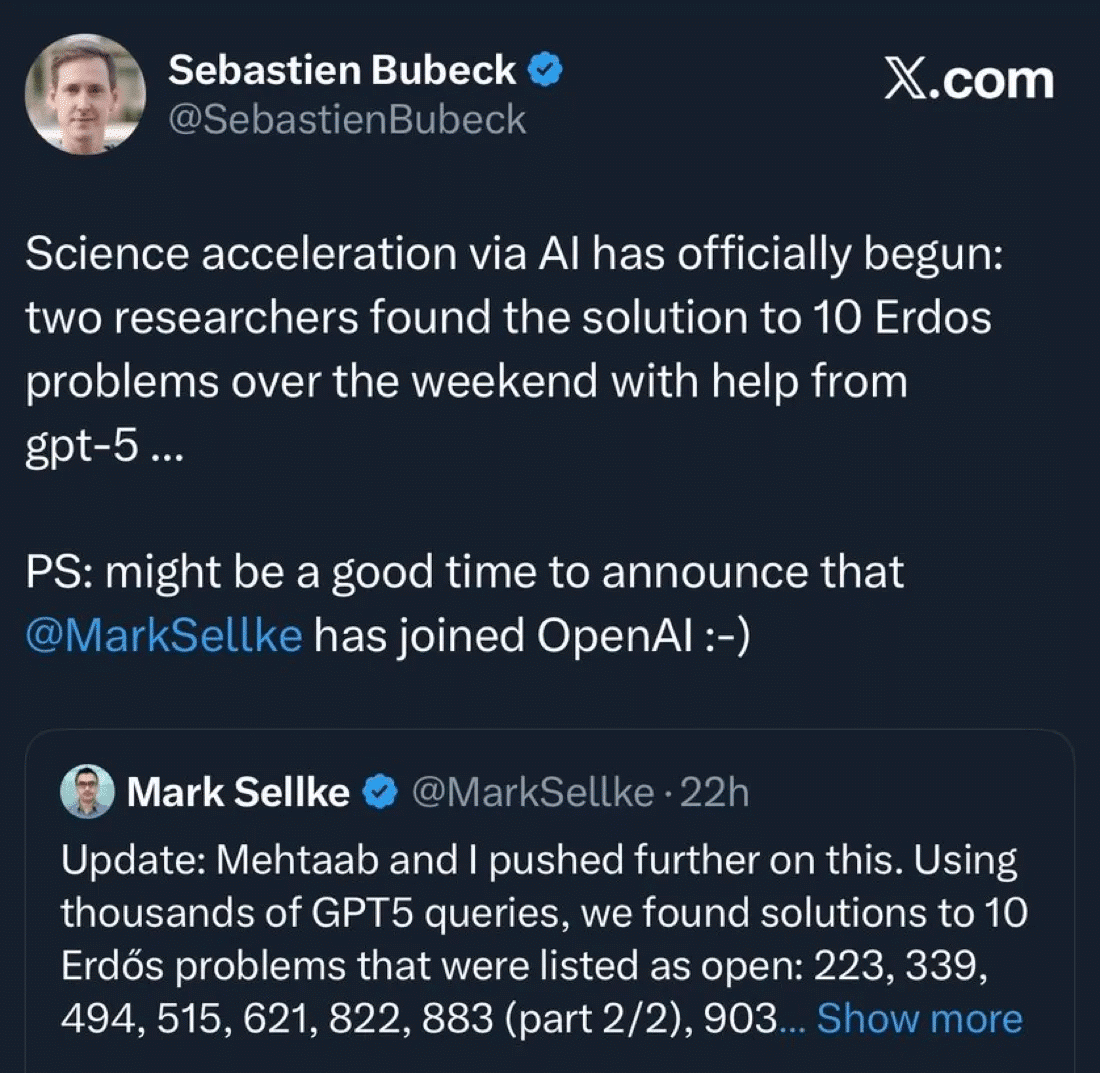
A recent episode offers a useful illustration. AI analyst Gary Marcus reports at his substack that an OpenAI, programmer, Sebastien Bubeck, was claiming that ChatGPT5 had solved a number of otherwise unsolved math problems posed by Paul Erdős (1913–1996):
Solving a whole bunch of unsolved Erdös problems (a famous set of mathematical conjectures) would indeed be a big deal.
A lot of people were excited; 100,000 people viewed his post on X.
“Erdosgate,” October 20,2025
But it wasn’t true. ChatGPT5 had not solved any Erdös problems:
Alas, “found a solution” didn’t mean what people thought it did. People imagined that the system had discovered original solutions to “open problems” All that really happened is that GPT-5 (oversimplifying slightly) crawled the web for solutions to already-solved problems. “Erdosgate”
Bubeck has since deleted the tweet, which is reproduced here, and modified his claims, though not before attracting ridicule in the programmer community. Marcus comments, “I would hope that the whole thing would be seen as kind of teachable moment. Some people (I won’t name the guilty) were extremely quick to take Bubeck at his word. But why? The claim would have been extraordinary, and should have been vetted closely. I smell a really big dose of people believing what they want to believe.”
The bottom line
Because the number of hours any of us has in a given day to pay attention to any topic is limited (24 hours max), the amount of time taken up by nonsense is always at the expense of sense. So, for example, the quest for superintelligent AI means less time available for addressing real problems like the loss of knowledge production or the loss of global knowledge noted above — to say nothing of ongoing technical problems like hallucination and model collapse.
Ultimately, the AI knowledge system will be enriched or impoverished by human decisions, not by discovering a superintelligence.
