The Human Brain: My, What a Well-Organized “Kludge”!
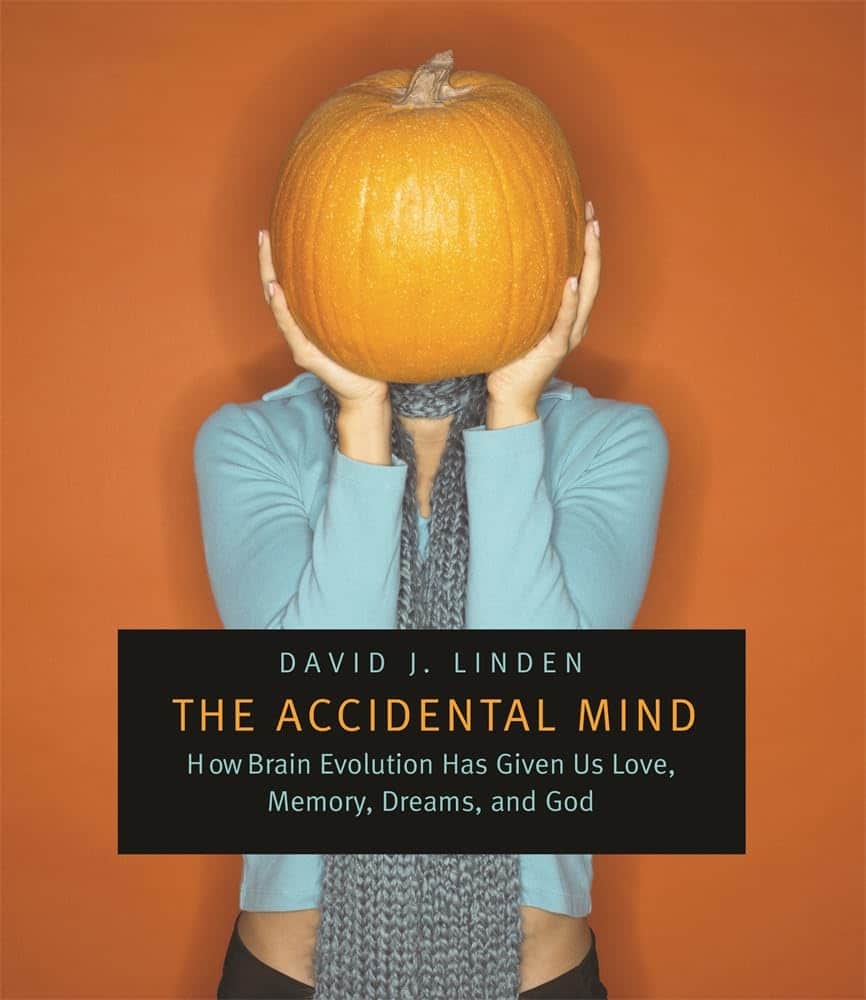
Looking back at a neuroscience book that was popular two decades ago is quite revealing in the light of new findingsTwenty years ago, the book of the breathless hour was The Accidental Mind: How Brain Evolution Has Given Us Love, Memory, Dreams, and God (2007) by Johns Hopkins neuroscientist David J. Linden:
You’ve probably seen it before: a human brain dramatically lit from the side, the camera circling it like a helicopter shot of Stonehenge, and a modulated baritone voice exalting the brain’s elegant design in reverent tones.
To which this book says: Pure nonsense. In a work at once deeply learned and wonderfully accessible, the neuroscientist David Linden counters the widespread assumption that the brain is a paragon of design–and in its place gives us a compelling explanation of how the brain’s serendipitous evolution has resulted in nothing short of our humanity. A guide to the strange and often illogical world of neural function, The Accidental Mind shows how the brain is not an optimized, general-purpose problem-solving machine, but rather a weird agglomeration of ad-hoc solutions that have been piled on through millions of years of evolutionary history. – From the Publisher
At Cell, pharmacologists Zachary S. Scheiner and Daniel R. Storm reviewed it confidently in “Your Brain the Kludge,”
Most neuroscientists, and the public at large, speak reverently of the human brain, which is often likened to a supercomputer. They marvel at its complexity and ability to perform even its most mundane tasks. But not David Linden. In his new book, The Accidental Mind, he describes the human brain as a kludge, “a design that is inefficient, inelegant, and unfathomable, but nevertheless works.”
The driving thesis of The Accidental Mind is that the human brain is poorly designed. Linden argues that the brain is composed of “crummy parts” that are slow and unreliable and overflowing with “anachronistic junk” left behind by millions of years of evolution. Ultimately, he speculates that these flaws are responsible for many of our uniquely human characteristics, including our predispositions for long-term relationships and religious thought. One problem with these arguments is that they assume we have already figured out how the brain works and are now in position to evaluate its design, or lack thereof. Another problem is semantic; design implies a designer.
Book Review Volume 55, Issue 4 p 542-543 August 16, 2007
Fast forward. Twenty years later, the first problem they mention is magnified. We haven’t got anywhere near figuring out “how the brain works”; if anything, as we discover more complexity, we may be further off than ever.
And today, another problem is not “semantic.” Linden was simply wrong in thinking that the human brain is a kludge.
Here’s a recently noted example of why it isn’t a kludge
Last month at Nautilus, Jake Currie wrote about the way that brains and bones work to heal each other:
Your brain is talking to your skeleton, and more than you probably realize. For example, doctors have long noticed something odd about people with traumatic brain injuries—their bones heal faster. When some brain cells are damaged, they release vesicles filled with proteins that travel to the bone stem cells and stimulate growth. Naturally, researchers began to wonder: If damaged brains can heal bones, can bones heal damaged brains?
“The shin bone’s connected to the… brain?,” September 25, 2026
Researchers at Southern Medical University in China tested this by damaging the brains of mice and pigs, producing traumatic brain injuries (TBI) and strokes. The animals were then fitted with electronic devices that tapped their shin bones for five days, rhythmically, a few times a second.
There turned out to be a previously unsuspected connection between bone and brain:
According to their study recently published in Nature Neuroscience, the tapping reduced brain cell loss, promoted neuron growth, and relieved chronic inflammation. It also increased both animals’ survival time and improved their motor function and ability to navigate mazes, suggesting the process led to less memory loss. “Connected to“
of a Piezo1 ion channel/
Mechanobiology Institute, Singapore
In their paper at Nature Neuroscience, Z Cai, Z Zhang, Y Wang, et al. found that a largish bone cell protein called PIEZO1 was doing the healing work: “In their tests of animals without PIEZO1, the team found none of the healing benefits of shin tapping.”
The researchers wrote, “Altogether, we establish a bone–brain axis in which bone endocrine function can be modulated by mechanical forces to enhance brain repair after injury.”
Currie comments, “The endocrine system operates via feedback loops, so in a way it would be even weirder if the brain-bone axis only went one way. But it’s still weird.”
But why does Currie think that the mechanism is “weird”?
The brain–bone system seems organized in such a way as to optimize healing opportunities in a world where there can’t be perfect solutions, only optimal ones. Of course, if words like “organized” or “design” bother some people, they are free to think of new ones that cover the same territory without distorting the meaning.
Meanwhile, going back to The Accidental Mind for a moment, why is a concept like the kludge brain that is clearly out of date and at odds with the facts supposed to be somehow more representative of science than an inference to design would be?
The more we learn, the harder it is to maintain—in the teeth of the evidence—claims that kludges and accidents, not design, account for our bodies.
