
Today’s Computer Chips — Measured in Beard-Seconds
Could we use beard-seconds as a measurement? Actually, we couldWe hear Greek prefixes such as giga, mega, and tera all the time. Each has a precise numerical meaning. Most of us simply interpret them as “big.” This can happen with currencies.
A convenience store in Rio de Janeiro was robbed of 100 reais, the currency of Brazil. An American headline translated the amount as “100 Brazilian dollars.” That sounds like a substantial haul! But it is worth only about twenty U.S. dollars.
The same sloppy understanding prevails at the other end of the scale. Prefixes such as centi, milli, micro, nano, pico, and femto each represent an exact power of ten, but most of us just hear them as “very small.”
It is both fun and informative to translate such prefixes into something more tangible. Elon Musk was recently celebrated as the world’s first trillionaire. That means he had the financial worth of a thousand billionaires. Each billionaire has worth a thousand millionaires so Musk is worth a million millionaires.
To put this in perspective, Austin, Texas has a population of about a million. So Musk could give every resident in Austin a million dollars. But “Keep Austin Weird” is the city’s unofficial motto. So if I were Elon, I wouldn’t do it.
We all have birthdays. In a previous column, I noted that I have celebrated my two billionth birth second. (My surprise party was memorable but very short.) Although I keep breaking my personal record for most consecutive days lived, I probably won’t make it to my third billionth birth second celebration. That would mean I was 95 years old.
A trillion seconds ago was long before Adam and Eve.
Could we use beard-seconds as a measurement?
We’ve all heard of the light year as a measure of the distance that light travels in one year. In the same spirit, we can define my new favorite metric: the beard-second. A beard-second is how long a man’s beard grows in one second. The distance an average man’s beard grows in one second is about 4 nanometers.1 That’s about 0.16 millionths of an inch (0.16 micro-inches).
The dimensions of modern computers
Modern computer chips are built with astonishing precision. Some of their smallest features measure only 2 nanometers..2 Now imagine placing one of those microscopic structures beside a man’s growing beard. Every second, the beard grows by roughly 4 nanometers — about twice the size of one of those tiny chip features. In just one minute, the beard advances the equivalent of 120 chip features. In an hour, it grows past 7,000 features. It’s a startling reminder of just how unimaginably small modern electronics have become. Something as ordinary as the slow, unnoticed growth of facial hair races past the dimensions of the microscopic architecture that powers today’s computers. That’s mind-blowing!
In case you’re wondering, a beard-second is longer than a fingernail-second, and a fingernail-second is longer than a toenail-second.3 In fact, a toenail-second (about 0.6 nanometers) is about half the length of a fingernail-second (about 1.3 nanometers.)
So in a race between a fingernail and a toenail, never bet of the toenail.
The Smallest Length
The Planck length is often regarded as the smallest meaningful length in physics. To image an object this size, the wavelength of the probing radiation must be shorter than the object itself. But shorter wavelengths correspond to higher frequencies and higher frequencies require more energy. At the Planck length, the energy needed to probe such a tiny distance would be so concentrated that it would collapse into a microscopic black hole, preventing any measurement. The Planck length appears to be a fundamental limit beyond which direct observation may not be possible.4
The Planck length is really small. In fact, there are over a hundred times more Planck lengths in a beard-second than there are beard-seconds in a light year. There are 2.48 x 1026 Planck lengths in one beard-second and “only” 2.73 x 1024 beard-seconds in a light year.
Wow. (We’ll delay the arithmetic for these numbers for later in the column.)
If a Planck length were scaled up to 1 inch, the diameter of a proton (about 1.7×10⁻¹⁵ meters) would scale to hundreds of light-years.
Moore’s Law states that the number of transistors on a computer chip doubles about every two years. But Moore’s Law must eventually stop at the Planck length. So it still has a long way to go, assuming the enabling imaging technology is developed.
 Image courtesy of Robert J. Marks
Other Weird Measures
Comedian Steven Wright quips “I’m not afraid of heights. I’m afraid of widths.” Here’s some interesting ways to measure widths. (Read on. Don’t be afraid.)
We’re all familiar with volume measures like cubic inches and cubic feet. Volumes can be made into lengths by taking the cube root of the volume. The cube root of a cubic inch is an inch.
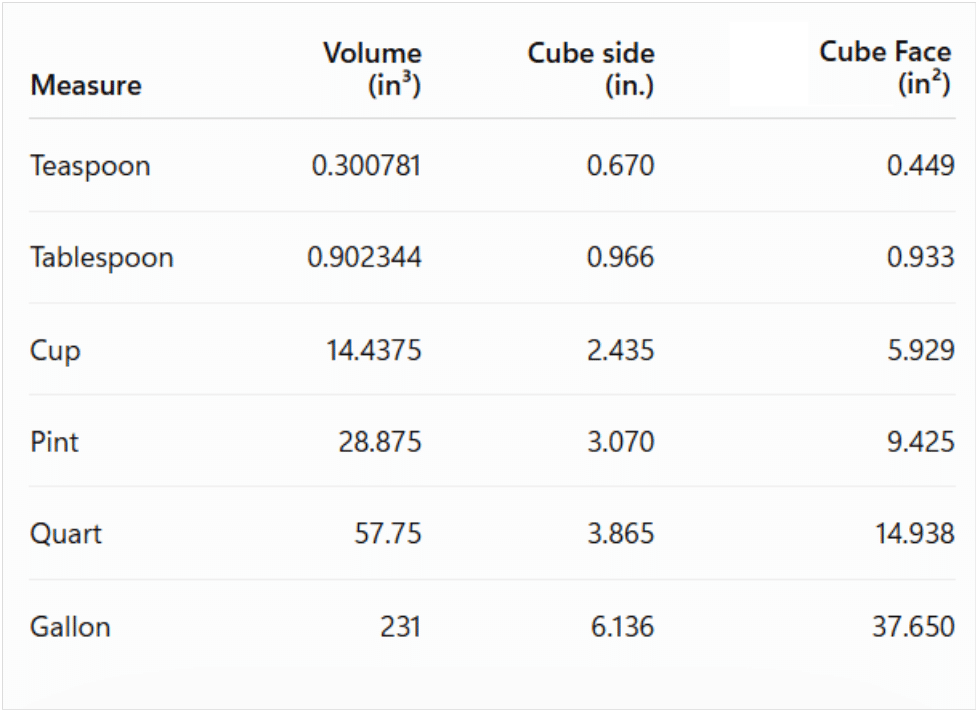
Consider the figure of the cube shown. Assume there is a volume of one gallon in the cube. A U.S. gallon contains 231 cubic inches. The length of each side of the cube is the cube root of 231 cubic inches, or approximately 6.136 inches. Let’s call this distance a gallon-length. So two gallon-lengths is about a foot. I am about 12 gallon-lengths tall.
Areas can also be made from volumes. Consider the square corresponding to a face of the cube. The area of the face of the cube is equal to the square of the cube side or, as an equivalent, the volume raised to the two-thirds power. A gallon-area is equal to 6.136 x 6.136 = 37.60 square inches.
Shown is a convenient table of lengths and areas for common English measures of volume. For example, we see that a tablespoon-area is about equal to a square inch.
You can have a lot of fun inventing everyday instructions with these new units. For example, a gallon of paint typically covers about 350 square feet, which is equivalent to approximately 1,339 gallon-areas. One gallon of paint covers 1,339 gallon-areas! The statement is perfectly accurate, yet delightfully confusing.
If you don’t find this interesting, well, you are just not a nerd.
The Arithmetic
For those interested, here is, as promised, the arithmetic showing there are more than a hundred times as many Planck lengths in a beard-second as there are beard-seconds in a light year.
Take one beard-second as approximately 4 nanometers Therefore, the number of Planck lengths in one beard-second is
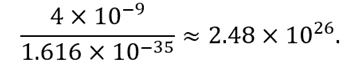
So one beard-second contains about 248 septillion Planck lengths. A light-year is

So the number of beard seconds in one light-year is therefore

So one light-year contains about 2.37 septillion beard-seconds. Comparing, we see that there are about 105 times more Planck lengths in one beard-second than there are beard-seconds in one light-year since

Fascinating.
[1] S. Maurer, “The male beard hair and facial skin—Challenges for shaving,” International Journal of Cosmetic Science, vol. 38, no. 1, pp. 3–11, Feb. 2016. https://onlinelibrary.wiley.com/doi/10.1111/ics.12328
[2] S. K. Moore, “TSMC Lifts the Curtain on Nanosheet Transistors,” IEEE Spectrum, Dec. 2023. https://spectrum.ieee.org/tsmc-n2
P. Ralston, “IBM Introduces the World’s First 2-nm Node Chip,” IEEE Spectrum, May 2021. https://spectrum.ieee.org/ibm-introduces-the-worlds-first-2nm-node-chip
[3] S. Yaemsiri, N. Hou, M. M. Slining, and K. He, “Growth rate of human fingernails and toenails in healthy American young adults,” Journal of the European Academy of Dermatology and Venereology, vol. 24, no. 4, pp. 420–423, Apr. 2010. https://onlinelibrary.wiley.com/doi/full/10.1111/j.1468-3083.2009.03426.x
[4] C. Rovelli, “Loop Quantum Gravity,” Living Reviews in Relativity, vol. 1, no. 1, 1998 https://link.springer.com/article/10.12942/lrr-1998-1
