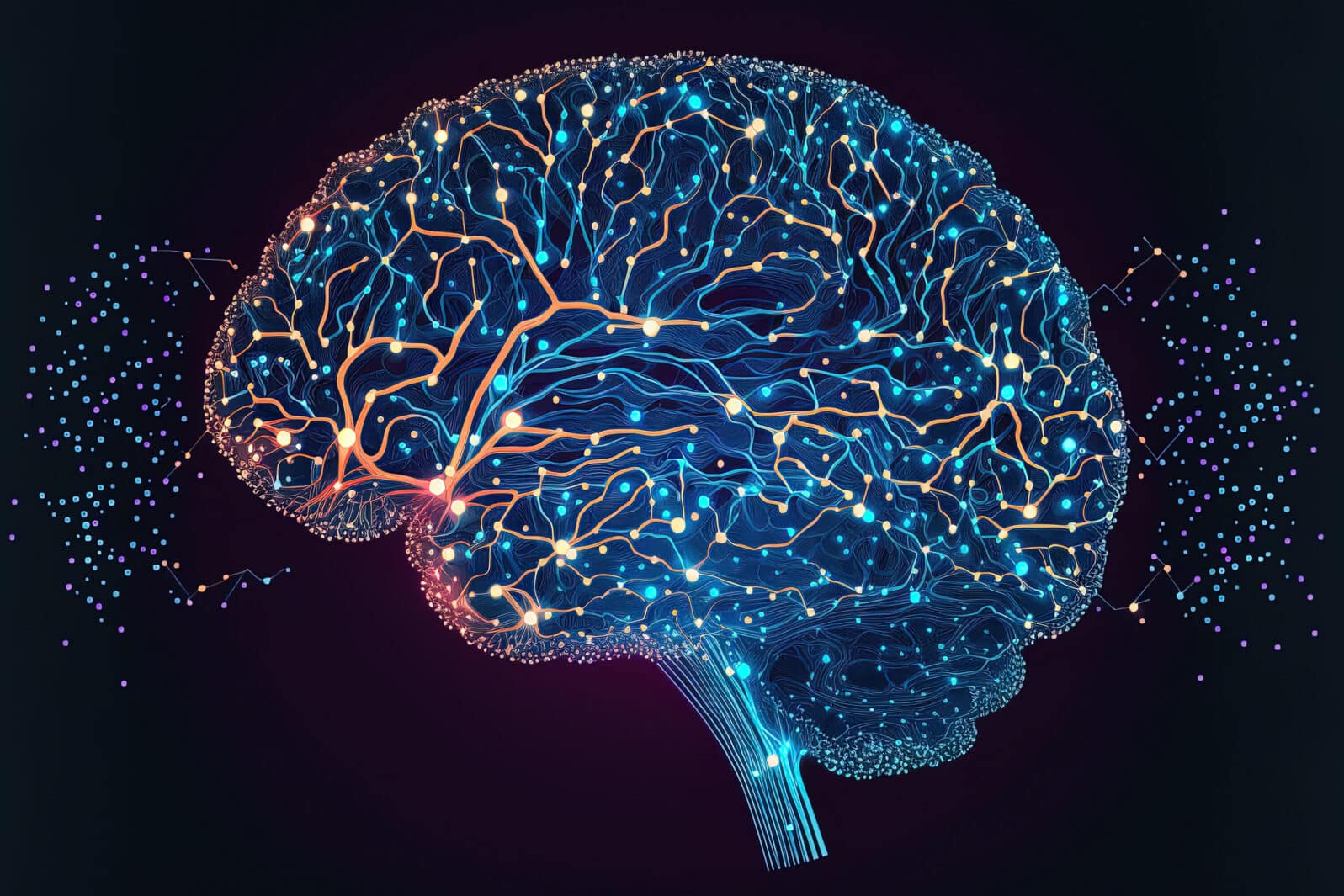
Is “The brain is a computer!” One of Science’s Biggest Mistakes?
If so, the mistake throws a wrench into claims that conscious computers can ever be builtAt IAI.TV, University of Colorado philosopher Dorothea Olkowski takes this on:
Artificial intelligence is advancing on the assumption that the brain is essentially a computer and if that is true, replicating the mind in silicon is only a matter of time. Philosopher Dorothea Olkowski argues this is one of the biggest mistakes in the history of science. Consciousness does not originate in the cortex, the seat of reasoning and language, but in the brainstem, the most ancient part of the brain, shaped by body chemistry and emotion. The brain’s signalling system is too chemically complex, too slow-acting, and too entangled with the whole body to be reduced to the simple yes/no binary logic that underlies all computation.
“The brain is not a computer” IAI.TV July 21, 2026
The mistake, in her view, is assuming that consciousness is a function of a specific part of the brain, the cerebral cortex. Following neuropsychologists Jaak Panksepp (1943-2017) and Mark Solms, she locates consciousness in the brain stem instead:
Panksepp fled the cudgel of behaviorism—the supposition that all behavior is merely an effect of external forces on an otherwise blank-slate mind—to study so-called “primary process mechanisms”: seeking, rage, fear, lust, care, panic, and grief. What makes his work so radical is his assertion that these primary processes, including play, do not originate in the neocortex—the most recently evolved region of the brain, responsible for reasoning and language—but rather, they arise from the most ancient one, the brainstem.
But this is not just another float…
… in the long parade of efforts to deny the significance of explicitly human consciousness:
By contrast, the ability to have thoughts about experiences is a secondary level of consciousness arising largely in the upper limbic system, and only the third level—reflection, or thoughts about thoughts—is a function of the neocortex.
So we could perhaps think of our human consciousness as a third storey?
When Solms talked with neurosurgeon Michael Egnor on a podcast a few years ago, this topic came up:
[Mark Solms:] … if you damage just a tiny area of the reticular core of the brain stem, roughly two cubic millimeters in extent, in other words, the size of a match head, then the lights go out. Consciousness is lost entirely. On the other hand, there are children who are born with absolutely no cerebral cortex, a condition called hydrancephaly, and these kids are conscious. They’re conscious in the sense that they wake up in the morning, and they go to sleep at night, but more interestingly, they are emotionally responsive to their environments. (November 6, 2021)
Egnor agreed with Solms’s’ observation that consciousness does not reside in the cortex: “Every neurosurgeon knows that. That’s crystal clear. And it’s remarkable that so much of neuroscience doesn’t know that…”
He offered examples from his practice:
[Michael Egnor:] I have a patient who’s had most of his brain destroyed. He’s a young man who had an arteriovenous malformation of his brain (hemorrhage) about 30 years ago when he was a small child, and it destroyed most of his brain. I see him in the office, he has a shunt for hydrocephalus, for fluid on his brain. He can’t speak very well and he sits in a wheelchair. But he’s actually an extremely perceptive person. His family says that he understands other people’s emotions and thoughts better than most people do. I’ve got a young girl who’s missing at least half of her brain, including a lot of her frontal cortex, who just recently graduated from high school as an honor student. She’s a brilliant child, a perfectly normal kid.
So, what Mark says is completely true. Consciousness certainly doesn’t come from the cortex. Where it comes from is a whole another fascinating question. But I found that what’s in the neuroscience textbooks simply doesn’t match up to real everyday experience. (November 7, 2021)
How does this relate to computers?
The key problem with the claim that computers can be conscious is that the messy processes of the brain that enable the various layers of consciousness bear no relationship to what happens in computers, Olkowski says:
What is controversial—and what matters enormously for the question of artificial intelligence—is the nature of the signalling involved. When neurons transmit messages using molecules called neurotransmitters, in addition to targeted binary (yes/no) neurotransmission—often associated with digital computation—there is a second type of transmission called post-synaptic modulation. It is described as a messy, chemical process arising from the brainstem and other subcortical structures, and even from non-neurological bodily structures. These neuromodulators—chemical messengers that regulate the overall state of the brain—come from all over the body, including the pituitary, adrenal, thyroid, and sex glands, as well as the hypothalamus and especially the brainstem. They wash over the network and regulate the overall state of the cortex, processing information differently depending on the emotional state involved. This process does not resemble what takes place in a computer—even though it is probabilistic and adjusts to the current situation—because it also has slow-acting and long-lasting effects as chemicals linger and habitual states are established. “Is not a computer”
By the way, whatever happened to the Hard Problem of consciousness?
 Image Credit: Murda -
 Claims about computer consciousness just around the corner overlook the fact that consciousness is very difficult to even define, let alone explain. Egnor and I were discussing this the other day, in connection with the book we are writing on near-death experiences:
[Michael Egnor]: You acquire knowledge through your senses. Let’s say I want to know if [someone] is conscious.
And I do that quite a bit professionally, in the sense that I’m a doctor, and I evaluate people who are in coma. So I want to find out if they’re conscious. So I use my senses. I’ll go into the room. I’ll talk to the patient. I’ll look at how they react. I’ll, you know, check the pupils and do all kinds of things. And through my senses I acquire knowledge. And I integrate this knowledge and reach a decision as to whether this person is conscious or not.
But that’s not how we know we’re conscious. The way I know I’m conscious is not a kind of knowledge. If I couldn’t see, feel, hear, touch. I’d still know I was conscious, but I couldn’t know if you were conscious. So that my certainty about my consciousness is not a kind of knowledge.
Because it doesn’t come through my senses. It comes through my experience. And what Wittgenstein would say is that we don’t know we’re conscious. We have consciousness. It must be experienced.
Actually, computers aren’t even the sort of thing for which consciousness is relevant. Dogs are, and maybe frogs, but not computers.
