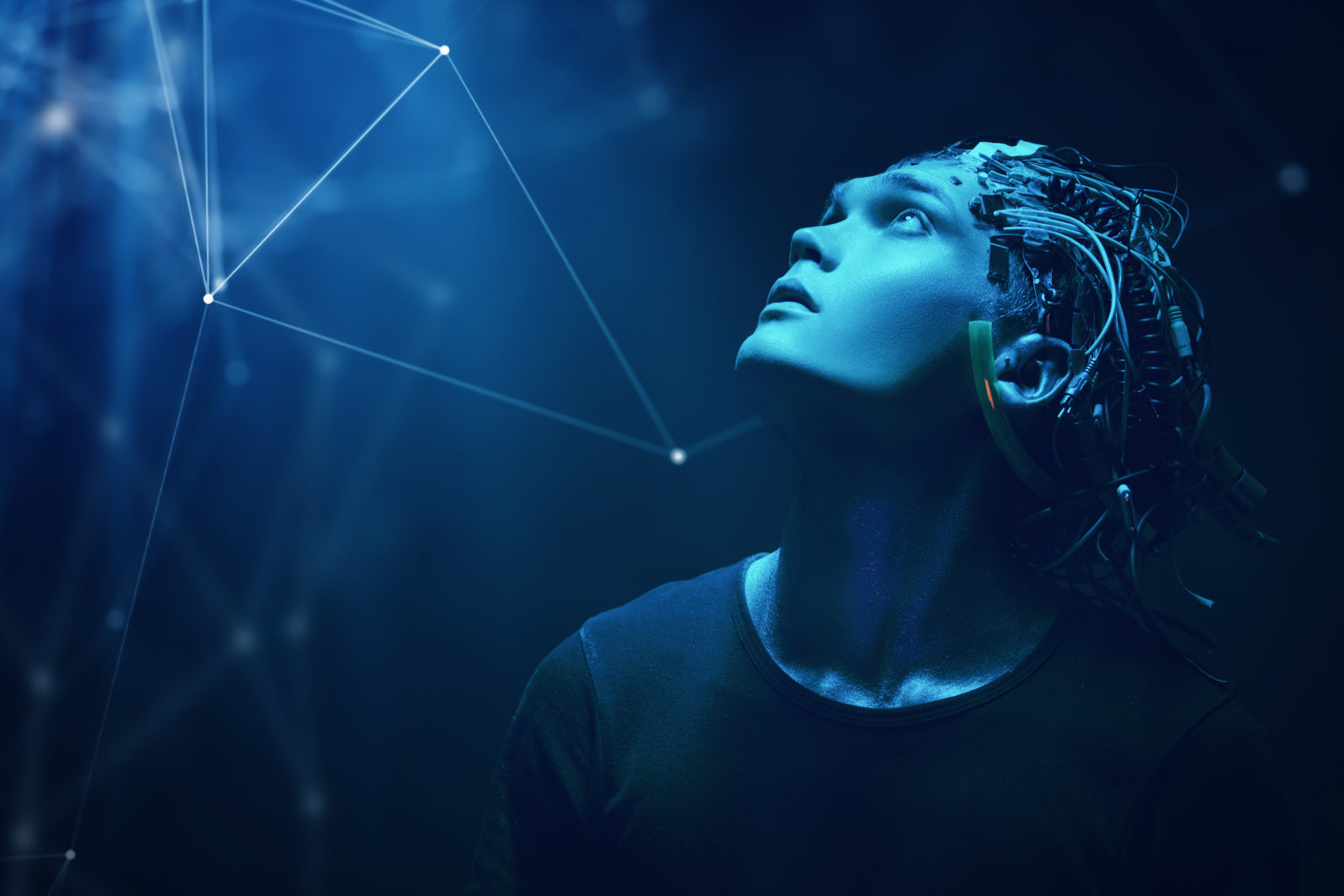
Is Berkeley’s Universe a Spiritual Hologram
Berkeley looks from within as his starting point.This abridged republished article first appeared in New English Review
Born in County Kilkenny, Ireland, on 12th March 1685, Irish philosopher George Berkeley studied at Trinity College, Dublin. He became a Fellow in 1707 and this required him to be placed in clerical orders, thus leading to his ordination into the Anglican Church.
In 1710, he published The Principles of Human Knowledge but it failed to win over readers to his immaterial theory. He then published a more popular version, The Three Dialogues Between Hylas and Philonous, in 1713. Much of his philosophy was regarded as silly by other philosophers during this period but they couldn’t refute it. So, what to make of the Dialogues? According to Berkeley, everything is perceived in the mind of God.
For Berkeley, God is the basis for improving one’s life, not damaging it, and a common-sense view of life is the best path to achieving such a goal. Berkeley was unique and quite happy in his philosophical world view, while he thought other philosophers throughout history were usually frustrated and complicated matters by analysing everything beyond the reach of human reasoning.
Being reasonable for Berkeley is being anti-sceptical and acknowledging that the only ‘real’ things that exist in the world are spirits who are created by an infinite Spirit, God. Put simply, the whole of reality is mental (certainly in the 21st century, in more ways than one!).
Now at this point, one might argue that this so-called ‘real world’ does not deserve the title of reality. But for Berkeley it is, to a degree, in that it is a kind of second-class reality always one step in the shadows of God’s Mind and the minds of finite beings. What we perceive, as matter, plays second fiddle to Spirit. This philosophical theory was developed as an answer to scepticism and atheism that had crept into contemporary philosophy.
Berkeley hated atheism and wanted to put God centre stage, acknowledging that an Absolute Observer must reign supreme over perceiving reality. Such a supernatural eternal Absolute Entity would not require the multiplication of causes of beyond what is necessary to explain itself.
However, human ideas/consciousness require an explanation for its meaning as the alternative of solipsism (the belief that only oneself exits and everything else is an illusion) is less credible for explaining one’s existence. So, we are left with the ultimate question: is consciousness/ideas connected to and part of God’s Mind?
Are the words that you are now reading on this page, including the backdrop to wherever you are reading, part of the conceptualized reality of a Supreme Entity, of which our collective consciousness is a manifestation? Berkeley believes that every-day objects are such a manifestation with multiple visual aspects that can change depending upon the circumstances. This also brings into play the problem of appearance and reality.
Take for example a fingerprint. If asked to describe one, the obvious answer would be that it’s a small black blob, about two-inches in circumference, with whirly lines going through it. The philosopher Bertrand Russell would call this favouritism, as we tend to view objects from an ordinary point of view under usual conditions of light, but the other colours/shapes which appear under other conditions have just as good a right to be considered real.
In other words, if we look a little closer, through a powerful microscope, our conventional idea of what a fingerprint looks like takes on a whole new meaning. For here we see something that resembles a huge mountain range, a kind of dark grey version of the Himalayas.
And if we stand back from the fingerprint, say about 20 feet, it looks like a tiny black spot (without the whirly bits). The same applies to everything else we perceive—from tables and chairs to mountains and oceans. But we describe most everyday objects from the very convenient distance, usually a couple of feet away, of a human perceiver, with its meaning relative to how such a perceiver thinks.
Can we ever know what reality looks like if everything is observer relative? This appearance-and-reality question has dogged philosophers for thousands of years, whereas scientists don’t waste time with endless speculation and abstract analysis. In recent years, many physicists have claimed to provide “some of the clearest evidence yet” that our universe could be just one big projection: a hologram. But that leads to another question: who is operating the hologram?
On Berkeley’s Idealism, scientists could be accused of philosophically putting the cosmological cart before the metaphysical horse, i.e. the so-called ‘world’ of phenomena before initial experience of it. Some scientists would argue that the tree fell and made a sound because it is part of the material world, which exists independently of our consciousness. In other words, it is mind-independent. The same, they would argue, applies to the universe and all the heavenly bodies it contains. But then most scientists are not philosophers like Berkeley. Berkeley would have probably thought that scientists inadvertently invent the rules in order for us to play the ‘material’ game of life.
But this can be a good thing, in that it gives us a kind of practical structure to our day-to-day living. Ultimately it tells us nothing about consciousness or why there is a weird, vast configuration in the form of what we call the universe. Or is it a God-constructed hologram, not the scientific atheistic view, a kind of cosmic window-dressing to keep us in awe of the astonishing vastness of the cosmos?
Berkeley’s philosophical theory was developed in contrast to the ideas of British philosopher John Locke (1632-1704). Locke made the distinction between ideas, immediately aware in perception to people, and material things caused by such ideas. This distinction runs counter to Berkeley’s philosophy, in that ideas are the first (most immediate) things that spark an awareness in human beings, as in sound, touch, sight, smell, and so forth.
Locke was trying to find out what is it that is out there; Berkeley looks from within as his starting point. Chairs, tables, trees and everything in the so-called material world are not active in the same way as minds are. Berkeley is confident in the knowledge that such objects, unlike minds, are not perceiving and do not have ideas (that’s panpsychism). And everything is in the infinite Mind of God.
In Of The Principles Of Human Understanding he wrote:
“It is indeed an opinion strangely prevailing among men that houses, mountains, rivers and in a word, all sensible objects, have an existence, natural or real, distinct from their being perceived by the understanding . . . For what are the aforementioned objects but the things we perceive by sense? And what do we perceive besides our own ideas or sensations? And is it plainly repugnant that anyone of these, or any combination of them, should exist unperceived.”
But what if your perception is all there is—without God? As mentioned, this is called solipsism, meaning reality is an illusion and only you exist reading these ‘imaginary’ words, which you think were written by someone else. Your mind, and your mind alone, is just one uncanny brutal fact. Other ‘people’ are just phantoms in your imagination. This seemingly irrefutable argument can be rejected by a leap of faith based on only a mad person would believe in it. However, Berkeley’s answer to solipsism is God can perceive sensations independently of us, thus allowing “things” to exist while we are not actually looking at them.
But what if God is not the good God that Berkeley believes in but an evil demon deceiving you? Such a demon, right now, is giving you a hint of his existence by conjuring up the text that you are reading. Even the ‘fictitious’ Berkeley has been invented to deceive you for the amusement of this evil demon. This hypothesis, from French philosopher Rene Descartes (1596-1650), throws doubt on the evidence of your senses. The demon has created the astonishing illusion which is your world. This is similar to the popular movie ‘The Matrix’. In it, reality perceived by the humans is really the Matrix: a simulated reality created by sentient computers.
But Descartes notes that even if such an evil genius existed, there is one thing that he, Descartes, knows for sure: “I think, therefore I am.” And he believes he cannot be deceived of this. Berkeley would probably phrase it another way: “I think; therefore, God exists.” The Greek philosopher Plato (circa 428-c.348) would attribute his existence and thinking on a higher form. Chairs, tables, mountains, oceans are reflections of the real objects, which he called the Form.
He gives this analogy of a cave where some slaves are shackled in chains. These slaves see a series of shadows on the cave wall, passing back and forth, which they take to be reality. One of the prisoners is released and brought up near the cave’s entrance, where he sees a fire and, in front of the fire, people are walking around carrying statues, animals, everyday objects. The prisoner, rubbing his eyes because of the great light caused by the fire, thinks to himself: “I’ve been misled.” Up to that point, he had been seduced by what he immediately saw before him. The shadows where just representations of the higher order of forms.
There is no doubt that Berkeley views God as the Absolute Form with the highest order of mind, and the everyday ‘objects’ making up the furniture in the so-called universe being immaterial reflections.
In The Principles Of Human Knowledge he writes:
“. . . If he can conceive it possible either for his ideas or their archetypes to exist without being perceived, then I give up the cause; but if he cannot, he will acknowledge it is unreasonable for him to stand up in defence of he knows not what, and pretend to charge on me as an absurdity the not assenting to those propositions which at bottom have no meaning in them. It will not be amiss to observe how far the received principles of philosophy are themselves chargeable with those pretended absurdities. It is thought strangely absurd that upon closing my eyelids all the visible objects around me should be reduced to nothing; and yet is it not this what philosophers commonly acknowledge, when they agree on all hands that light and colours, which alone are the proper and immediate objects of sight, are mere sensations that exist no longer than they are perceived . . . ?”
For Locke, colours are relative to the minds of perceivers. He called them secondary qualities, along with smells and tastes because they were ‘mind-dependent’. However, the shape of an orange is a primary quality. And such material objects, according to Locke, are fully mind-independent regardless of how they look to us. Berkeley does not agree. He points to subjective experiences such as the sensation of pain. Would the experience of pain exist somewhere out there in mind-independent land? So, for Berkeley, Locke’s primary and secondary qualities do not make sense.
But back to colours. The Australian philosopher Frank Jackson highlights what it is like to see a colour, as opposed to its so-called physical or structural properties. Imagine a woman called Mary who is an expert on human vision, particularly colour perception. Mary has never seen a colour and has spent all her life working in a black-and-white laboratory with some grey areas. Even her TV is black and white. She knows what happens in humans’ brains when they see a colour, as she spent her life reading about light waves, particles and optical perception.
One day, feeling extremely bored, she walks outside the lab and sees a front yard with green grass. Mary learns something new: what it is like to see something green. All the science on colour optics in all the books she read are nothing like what she has just experienced. All the hypothetical information on physical and structural properties of colour experience that she learned in the lab have been blown away. She has, for the first time, learned about the conscious aspect of seeing green. And that conscious aspect appears to be non-physical.
Berkeley was a Christian and his Idealism encompasses other ‘sub’ minds, a kind of community of souls in a non-physical realm. In the end, hologram or no hologram, speculation or scepticism on the universe and the world are a waste of time. Life is short and to lose your eternal soul sitting on the fence of agnosticism is worse than tragic: it’s the stuff of nightmares if God exists.
Hebrews 11:3 tells us, ‘By faith we understand that the universe was created by the word of God, so that what is seen was not made out of things that are visible.’ A faith in God based on reason and trust (not blind faith) is all we need for physical, spiritual fulfilment and truth. The truth is more important than a worldview you want to live with based on a false perception that is ‘my reality.’
